National Plumbing Code Chapter 1 — Administration
NPC 2000
← All Chapters Ch. 2: Definitions Ch. 3: General Regulations
Chapter 1 · Administration

ADMINISTRATION Sections 100–108

Chapter 1 establishes who may do plumbing work, what documents are required, how permits are issued, the inspection process, and conditions for connecting to utilities. The central rule: only a Registered and Licensed Master Plumber (RLMP) may obtain a plumbing permit or supervise plumbing work.

📋 9 Sections 🔒 RLMP Mandatory 📄 6-Set Plans Requirement 🔍 3 Inspection Stages
§100

Permit Required

NPC 2000 · Chapter 1 · Section 100
Code Requirement
100.1 No plumbing work shall be installed, altered, or repaired without first securing a permit from the Administrative Authority having jurisdiction.
100.2 The permit must be obtained before any work begins. Retroactive permits for completed work are subject to penalties.
100.3 The permit covers the installation as shown in the approved plans. Any deviation requires a revised permit.
When a Permit IS Required
New installationYES
Addition or alterationYES
Repair of existingYES
Routine maintenanceNO
Emergency repairAfter-the-fact
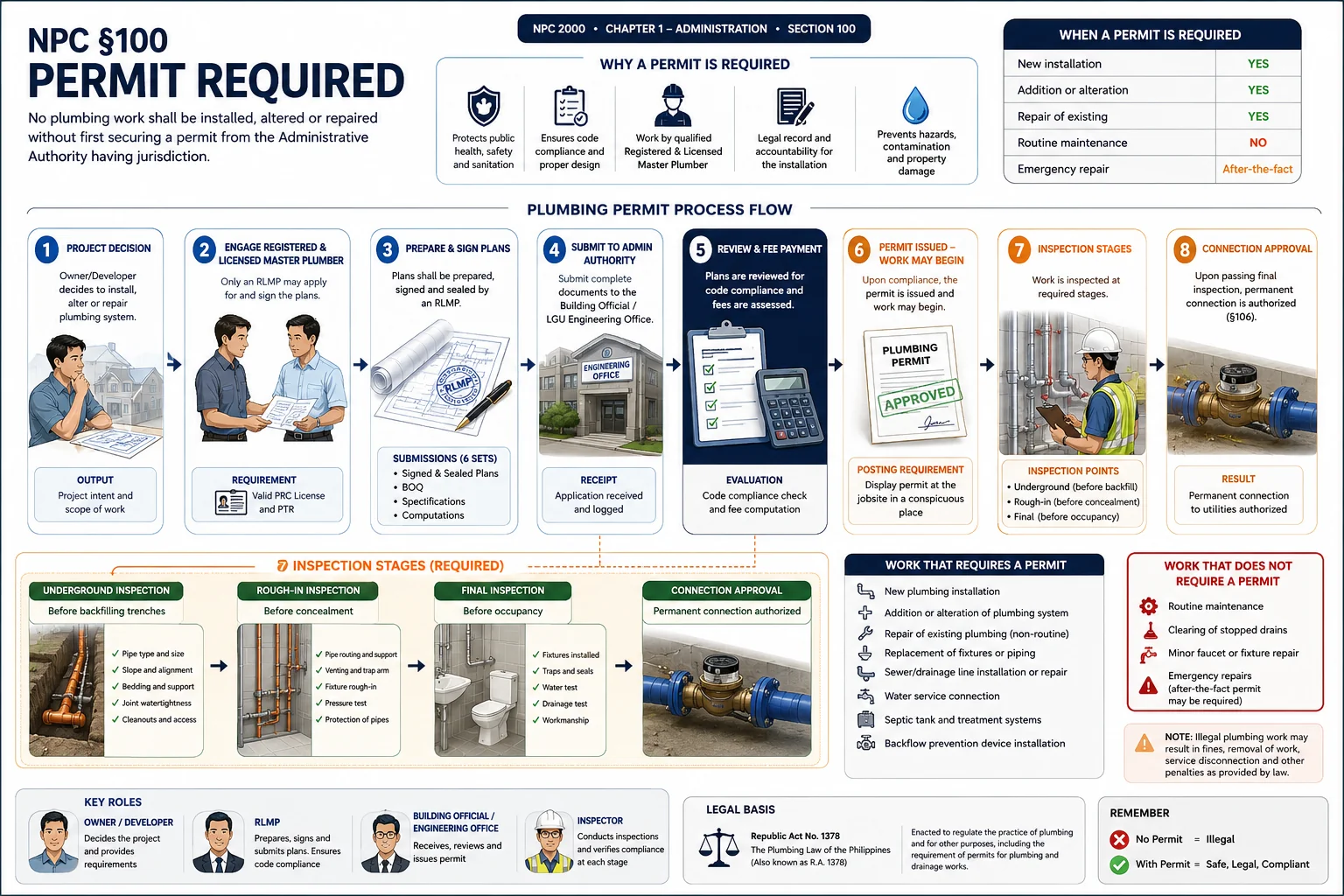
Permit Process Flow
1
Project Decision
Owner/developer decides to install plumbing
2
Engage a Registered & Licensed Master Plumber
Only an RLMP may apply — see §101
3
Prepare & Sign Plans
6 sets · signed & sealed by RLMP · with BOQ, specs, computations
4
Submit to Administrative Authority
Building Official / LGU Engineering Office
5
Review & Fee Payment
Plans reviewed for code compliance · permit fee assessed
6
Permit Issued — Work May Begin
Post permit at jobsite · comply with approved plans
Underground Insp.Before backfill
Rough-in Insp.Before concealment
Final Insp.Before occupancy
Connection Approval
Permanent connection to utilities authorized — §106
⚠️ Image needed — [CH1-DIAGRAM-A]: Annotated flowchart graphic showing the permit sequence with RLMP role highlighted at each decision point.
§101

To Whom Permits May Be Issued

NPC 2000 · Chapter 1 · Section 101
Code Requirement
101.1 No permit shall be issued to any person, firm, or corporation except to a Registered and Licensed Master Plumber (RLMP) holding a valid, unexpired, and unrevoked certificate of registration as required by RA 1378.
101.2 The RLMP is personally responsible and liable for the plumbing work covered by the permit.
101.3 An expired, suspended, or revoked PRC ID renders the RLMP ineligible to apply for or hold a permit.
RLMP License Requirements
Issued byPRC
LawRA 1378
Renewal3 years
CPD requiredYes
Key Rule: Only an RLMP may apply for and receive a plumbing permit. Property owners, contractors, or unlicensed plumbers cannot apply directly.
ℹ️ RA 1378 is the enabling law — "An Act to Regulate the Practice of the Trade of Master Plumber." It also establishes the Board of Examiners for Master Plumbers.
Who Can & Cannot Apply
Person/EntityCan Apply?
Registered & Licensed Master Plumber✅ Yes
Property Owner (non-plumber)❌ No
General Contractor❌ No
Journeyman Plumber❌ No
Plumbing Company (without RLMP)❌ No
RLMP with expired license❌ No
§102

Application for Permit

NPC 2000 · Chapter 1 · Section 102
Required Documents
102.1 All plumbing plans, drawings, diagrams, design analyses/computations, technical specifications, and bills of materials shall be signed and sealed by the RLMP.
102.2 Documents shall be submitted in six (6) sets with each application for a permit.
102.3 Required for all types of occupancy: residential, commercial, industrial, and institutional.
Submission Requirement
Number of plan sets6 Sets
Plan signatoryRLMP
Must include BOQYes
Design computationsYes
Technical specsYes
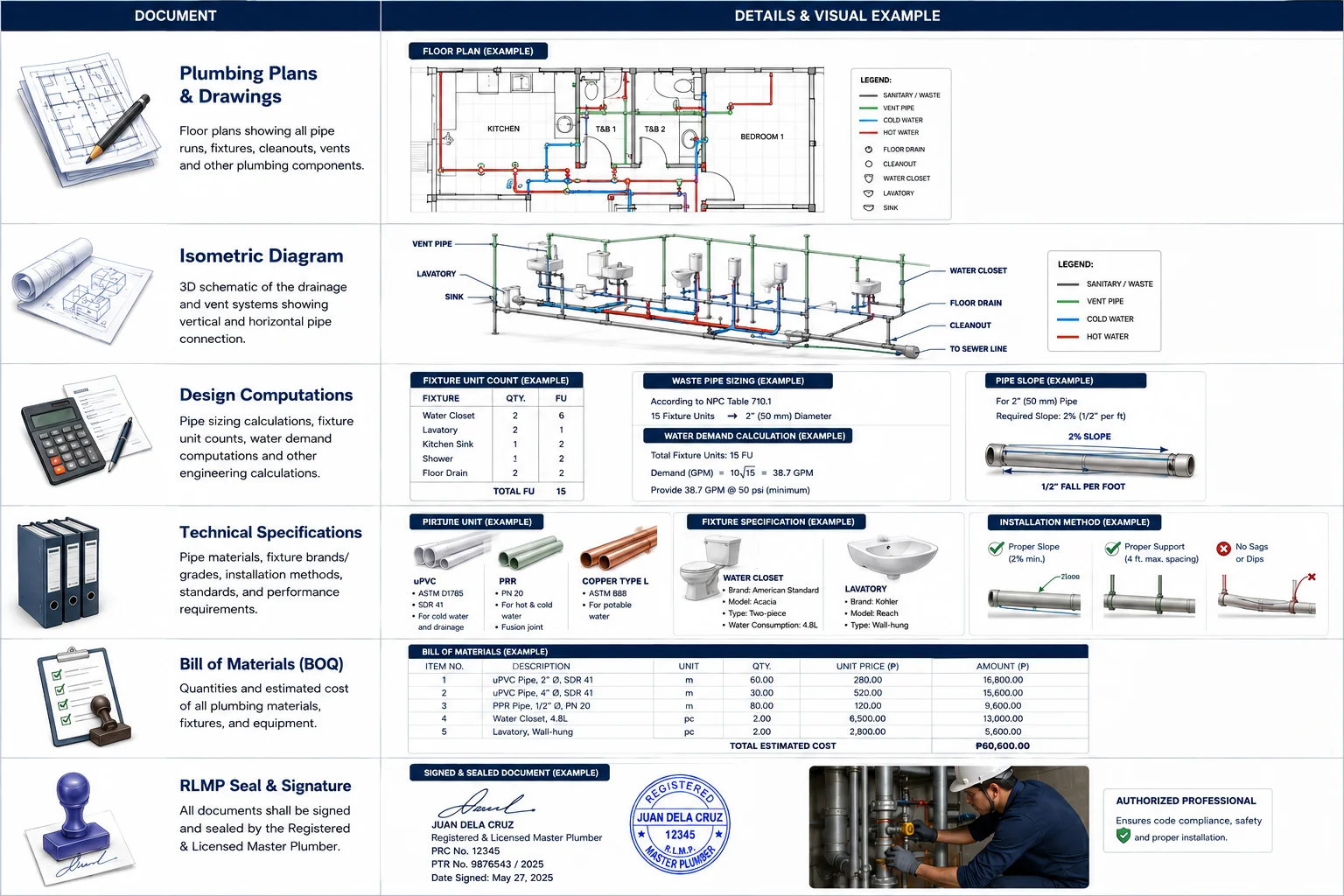
Documents Required Per Application
DocumentDetails
Plumbing Plans & DrawingsFloor plans showing all pipe runs, fixtures, cleanouts, vents
Isometric Diagram3D schematic of the drainage and vent systems
Design ComputationsPipe sizing calculations, fixture unit counts
Technical SpecificationsPipe materials, fixture brands/grades, installation methods
Bill of Materials (BOQ)Quantities and estimated cost of all plumbing materials
RLMP Seal & SignatureAll 6 sets must be signed and wet-sealed
⚠️ Image needed — [CH1-DIAGRAM-B]: Sample plumbing plan layout showing what a typical permit submission looks like — floor plan view with drainage lines, fixture symbols, and isometric diagram callout.
§103

Permit Issuance

NPC 2000 · Chapter 1 · Section 103
Code Requirement
103.1 The application, plans, technical specifications, and other required documents shall be reviewed by the Administrative Authority.
103.2 If the work conforms to the requirements of the Plumbing Code and other pertinent laws, and upon payment of the required fees, a permit shall be issued.
103.3 The permit is non-transferable. It is issued to the specific RLMP named in the application and for the specific project location.
103.4 If the RLMP of record withdraws from the project, work must stop until a new RLMP is designated and the permit is updated.
ℹ️ The Administrative Authority is typically the Local Government Unit (LGU) Building Official or the Office of the Building Official (OBO).
Plans Conformance Required Fee Payment Required Non-Transferable RLMP-Specific
§104

Application for Existing Systems

NPC 2000 · Chapter 1 · Section 104
Sub-sections
104.1 Additions, Alterations, or Repairs: Existing plumbing systems may be added to, altered, or repaired in compliance with the Code for new work. Non-compliant portions of the existing system shall not be made more deficient.
104.2 Change in Building Occupancy: If a building's use changes (e.g., residence to commercial), the plumbing must be brought into compliance with the requirements of the new occupancy.
104.3 Maintenance: Day-to-day maintenance (replacing a faucet washer, unclogging a drain) does not require a permit. However, the work must be done by a competent person and must not violate the Code.
104.4 Moved Buildings: When a structure is relocated, it must be brought into full compliance with current Code requirements before reconnection to utilities.
Work on Existing Systems — Permit Required?
Type of WorkPermit?Notes
Adding new bathroom✅ YesFull compliance required
Moving fixture location✅ YesAlteration
Adding floor drain✅ YesNew work
Replacing water heater✅ YesMay involve gas / new connections
Like-for-like fixture swap⚠️ MaybeCheck with LGU; usually no
Replacing faucet washer❌ NoRoutine maintenance §104.3
Unclogging drain❌ NoRoutine maintenance §104.3
Change of occupancy✅ YesMust meet new occupancy's requirements
§105

Inspection

NPC 2000 · Chapter 1 · Section 105
Code Requirement
105.1 No portion of any plumbing system shall be concealed until it has been inspected and approved by the Administrative Authority.
105.2 All Administrative Plumbing Personnel and Plumbing Inspectors shall be Registered and Licensed Master Plumbers.
105.3 The RLMP of record shall notify the Administrative Authority when work is ready for each inspection stage.
Inspection Stages
1st — UndergroundBefore backfill
2nd — Rough-inBefore concealment
3rd — FinalBefore occupancy
What is Inspected at Each Stage
StageWhat is CheckedTiming
Underground Building drain, sewer pipe, underground water supply lines — before trenches are backfilled After pipe laid, before soil is replaced
Rough-in All drain, waste, vent, and supply pipes in walls/ceilings before covering with lath, plaster, or other finishing After framing, before wall/ceiling finish
Final All fixtures installed and functional, all connections made, water test passed, no visible defects Before building certificate of occupancy
⚠️ Critical Rule: Covering any pipe before inspection approval is a code violation. The RLMP may be required to uncover the work at their own expense.
§106

Connection Approval

NPC 2000 · Chapter 1 · Section 106
Code Requirement
106.1 Permanent Connection: After the final inspection passes, the Administrative Authority shall issue written approval to permanently connect the plumbing system to the public water supply and/or sewer.
106.2 Temporary Connection: A temporary connection may be authorized by the Administrative Authority and endorsed to other agencies or government bodies (e.g., MWSS, LWUA, local water district) when urgently needed.
106.3 A temporary connection does not waive the requirement for eventual permanent approval and final inspection.
PERMANENT CONNECTION
  • → After final inspection passed
  • → Written approval from Admin Authority
  • → For occupancy and ongoing use
TEMPORARY CONNECTION
  • → Endorsed by Admin Authority
  • → For urgent/limited use only
  • → Does not replace final inspection
§107

Special Provisions

NPC 2000 · Chapter 1 · Section 107
Code Requirement
107.1 Board of Examiners Rulings: Interpretations and rulings of the Board of Examiners for Master Plumbers (under PRC) on any provision of the Code shall be binding on all parties.
107.2 Conflicts with Other Laws: When the Plumbing Code conflicts with any other law, ordinance, or regulation, the more stringent requirement shall apply.
107.3 Equivalency: Nothing in the Code shall prevent the use of alternative materials, design, or methods of construction not specifically prescribed, provided the alternative is approved by the Administrative Authority as equivalent.
ℹ️ Equivalency Rule: Alternative materials or methods (e.g., new pipe types not listed in §314) can be used if you demonstrate to the Building Official that they meet or exceed the Code's intent.
§108

Plumbing Fixtures Required

NPC 2000 · Chapter 1 · Section 108
Code Requirement
108.1 Every building intended for human occupancy shall be provided with sanitary facilities appropriate to the type of building, its use, and the number of occupants, as prescribed in Chapter 4.
108.2 Minimum fixture counts are based on occupancy classification (residential, office, assembly, institutional, industrial, etc.).
108.3 Where an existing building is altered or its occupancy changed, the fixture count must meet the requirements of the new occupancy. Reduction in fixture count is not permitted if it falls below the minimum.
Sample Minimum Fixtures (Residential — see Chapter 4 for full table)
FixtureDwelling Unit
Water Closet (WC)1 per unit min.
Lavatory1 per unit min.
Bathtub or shower1 per unit min.
Kitchen sink1 per kitchen
Laundry tray / washer hookupWhere provided
ℹ️ Section 108 sets the principle. The actual minimum fixture tables — broken down by occupancy type and occupant count — are found in Chapter 4 (Plumbing Fixtures).
Diagram Requests — Chapter 1

Images Needed for This Chapter

[CH1-DIAGRAM-A] — Permit process flowchart. Annotated version with RLMP highlighted at key steps. Decision diamonds: compliant? → permit issued / revise and resubmit.
[CH1-DIAGRAM-B] — Sample plumbing permit plan layout. Floor plan + isometric + BOQ callout. Labeled with what must be signed/sealed.
[CH1-DIAGRAM-C] — Inspection stage diagram. Building cross-section showing: underground piping → rough-in pipes in walls → finished building. Each stage labeled with what is inspected and when.