
House Drains & House Sewers
Chapter 12 governs the pipe that carries a building's excreta drainage from the building drain out to the point of disposal — the building (house) sewer. It sets the rule for when you must connect to the public sewer versus a private septic system, the approved materials and markings, the minimum size and slope of the sewer, cleanouts, the separation from potable water piping, the clearances in Table 12-1, and the closing of abandoned sewers.
Sewer Required
When you must connect to the public sewer — and when a private system is allowed
Every building containing plumbing fixtures, and all premises with drainage piping, shall connect to a public or private excreta sewerage system (§1201.1). The route of disposal depends on whether a public sewer is available:
- Public sewer available (within 61 m) — connection to the public sewer is mandatory.
- Public sewer not available (more than 61 m away) — drainage piping shall connect to an approved private sewage disposal system, e.g. a septic tank, approved by the Administrative Authority (§1201.2; see also Chapter 10).
Exception: a single-family dwelling already connected to an approved private system before a public sewer was built may continue to use it, with written Administrative Authority permission, where sufficient grade/fall to the public sewer is not available.
Damage to Public Sewer or Private Sewage Disposal System
What may never be discharged into the sewerage system
| Item | Rule |
|---|---|
| §1202.1 | Unlawful to deposit ashes, cinders, solids, rags, or flammable/poisonous/explosive liquids or gases, oils, grease, etc. into any fixture, catch basin, floor drain, interceptor, or sump connected to the excreta or storm drainage system, public/private sewer, septic tank, or cesspool, where such materials could cause damage. |
| §1202.2 | No rain, surface, or subsurface water may be connected to the excreta drainage system unless first approved by the Administrative Authority. |
| §1202.3 | No cesspool/septic tank effluent, seepage pit, or underdrain system may be connected to an excreta building sewer that leads to a public sewer main. |
| §1202.4 | No commercial food-waste grinder may be connected to a private or public sewage system without Administrative Authority permission. |
| §1202.5 | An approved watertight sewage/wastewater holding tank is required when ordered by the Administrative Authority or Health Officer to prevent contamination, damage, or nuisance. |
Building Sewer Materials
Approved house-sewer pipe, measured from the building wall
The building sewer, beginning 0.6 m from the outside face of the wall of the building or structure, shall be of such materials as approved by the Administrative Authority under the approval procedures of this Code (§1203.1). Jointing methods and materials shall comply with Chapter 13 — Joints & Connections (§1203.2).
| Material | Use | Restriction |
|---|---|---|
| Cast iron / ductile iron | ✓ Approved | Most durable for under-slab and building sewer |
| Series 1000 PVC-DWV | ✓ Approved | Most common in Philippine practice |
| Galvanized steel / wrought iron | ⚠ Limited | Under a slab on grade: requires a machine-applied outside protective coating — galvanizing alone is not adequate |
| Lead, copper, brass | ✓ Approved | Per material standards |
| Extra-strength vitrified clay | ⚠ Outside only | Subject to Administrative Authority approval per §1203.1 |
| Concrete sewer pipe | ⚠ Outside only | Subject to Administrative Authority approval per §1203.1 |
Markings
Identification of sewer materials and appurtenances
Size of Building Sewers
Minimum diameter and fixture-unit basis — Table 12-2
The minimum size of any building sewer shall be determined on the basis of the total number of fixture units drained by the sewer, in accordance with Table 12-2. No building sewer shall be smaller than 150 mm diameter nor less in size than the building drain it serves.
Table 12-2 — Fixture-Unit Loading on Building Sewer Piping (max / min)
| Size of Pipe | s = ½% (5.3 mm/m) | s = 1% (10.5 mm/m) | s = 2% (20.9 mm/m) |
|---|---|---|---|
| 152 mm (6″) | per Table | per Table | no minimum loading |
| 203 mm (8″) | 1,950 / 1,500 | 2,800 / 625 | 3,900 / 275 |
| 254 mm (10″) | 3,400 / 1,600 | 4,900 / 675 | 6,800 / 300 |
| 305 mm (12″) | 5,600 / 1,700 | 8,000 / 725 | 11,200 / 235 |
Each cell lists the maximum / minimum drainage fixture units (DFU) permitted on the building sewer at that pipe size and slope, exactly as printed in Table 12-2 of the Code.
Building Sewer Size & Slope Checker
Enter the proposed pipe diameter and grade to check §1205/§1206 compliance.
Grade, Support & Protection of Building Sewer
Standard slope, the permitted reduced-grade exception, and bedding/cover
§1206.1 — Building sewers shall be run in practical alignment at a uniform slope of not less than 2% (21 mm per meter) toward the point of disposal (the septic tank or the street sewer main).
| Pipe Size | Standard Grade | Reduced Grade (with approval) |
|---|---|---|
| 102–152.4 mm (4″–6″) | 2% (21 mm/m) | down to 1% (10.5 mm/m) |
| 203 mm (8″) and larger | 2% (21 mm/m) | down to 0.5% (5.3 mm/m) |
Exception, §1206.1: where it is impractical — due to the depth of the street sewer, structural features, or adverse arrangement of a building — to obtain a 2% slope, and with Administrative Authority approval, pipe 102 mm–152.4 mm in diameter may slope as little as 1% (10.5 mm/m), and pipe 203 mm and larger may slope as little as 0.5% (5.3 mm/m).
§1206.2 — Piping shall be laid on a firm bed; on made or filled ground, it shall be laid over a concrete cradle or other approved bed.
§1206.3 — No building sewer or drainage piping of materials not approved for underground use shall be installed less than 0.6 m from the outer face of the building/foundation wall, nor less than 0.3 m below the finished ground surface. This includes porches, steps, breezeways (covered or uncovered), roofed "porte cocheres," roofed patios, carports, covered walks, covered driveways, and similar structures.
Cleanouts
Placement, spacing, direction-change trigger, and manholes
§1207.1 — A cleanout shall be placed inside the building near the building drain/sewer connection, or outside at the lower end of the building drain, extended to grade (a two-way cleanout fitting may substitute for a single cleanout). Additional building sewer cleanouts shall be installed not to exceed 15 m on center in straight runs, and for each aggregate change in direction exceeding 135 degrees.
§1207.2 — No cleanout is required at the building drain connection point if the building sewer/branch is ≤3 m and is a short straight extension that already has a cleanout.
§1207.3 — All required building sewer cleanouts shall be extended to grade; under-building sewers follow the same cleanout requirements.
§1207.4 — Cleanouts shall open to allow cleaning of horizontal lines in the direction of flow, or at a right angle, except a wye-branch or end-of-line cleanout, which is installed vertically above the flow line.
§1207.5 — Cleanouts under concrete or asphalt paving shall be made accessible via a strong yard box with a hinged cover, or an extended top with a countersunk nut flush with the paving.
Sewer and Water Pipes
Separation of building sewer/drainage piping from potable water piping
§1208.1 — Building sewer or drainage piping of clay, or of materials not approved for use within a building, shall not run or lay in the same trench as water pipes unless:
- §1208.1.1 — The bottom of the water pipe is, at all points, at least 0.3 m above the top of the sewer/drain line; and
- §1208.1.2 — The water pipe is placed on a solid shelf excavated at one side of the common trench, with a minimum clear horizontal distance of at least 0.3 m from the sewer/drain line.
Where water pipes cross sewer or drainage piping of clay or non-approved materials, they shall be laid with a minimum 0.3 m clear above the sewer/drain pipe, and water-pipe joints shall be installed not less than 3 m away from the sewer line in both directions.
"Within the building" means within the fixed limits of the building foundation.
Location
Lot restrictions and minimum clearances — Table 12-1
§1209.1 — Except as provided in §1209.2, no building sewer shall be located on any lot other than the lot it serves, nor at any point closer than the minimum distances in Table 12-1.
§1209.2 — An abutting lot may be used to provide access/connection or additional space for a building sewer where there is a proper legal easement or recorded agreement with the Administrative Authority, binding on the heirs, successors, and assigns of the parties (§1209.2.1, §1209.2.2).
Table 12-1 — Minimum Horizontal Distance from Building Sewer
| Element | Minimum Horizontal Distance |
|---|---|
| Buildings or structures (incl. porches, steps, breezeways, roofed patios, carports, covered walks/driveways) | 0.6 m |
| Property line adjoining private property | Clear (see §1208) |
| Water supply wells | 15.2 m (may be reduced to not less than 7.6 m if the drainage piping is of materials approved for use within a building) |
| Streams | 15.2 m |
| On-site domestic water service line | 0.3 m (parallel; see §1208) |
| Public water main | 0.3 m (parallel) |
Crossings of a public water main require approval of the Health Department or other authority having jurisdiction.
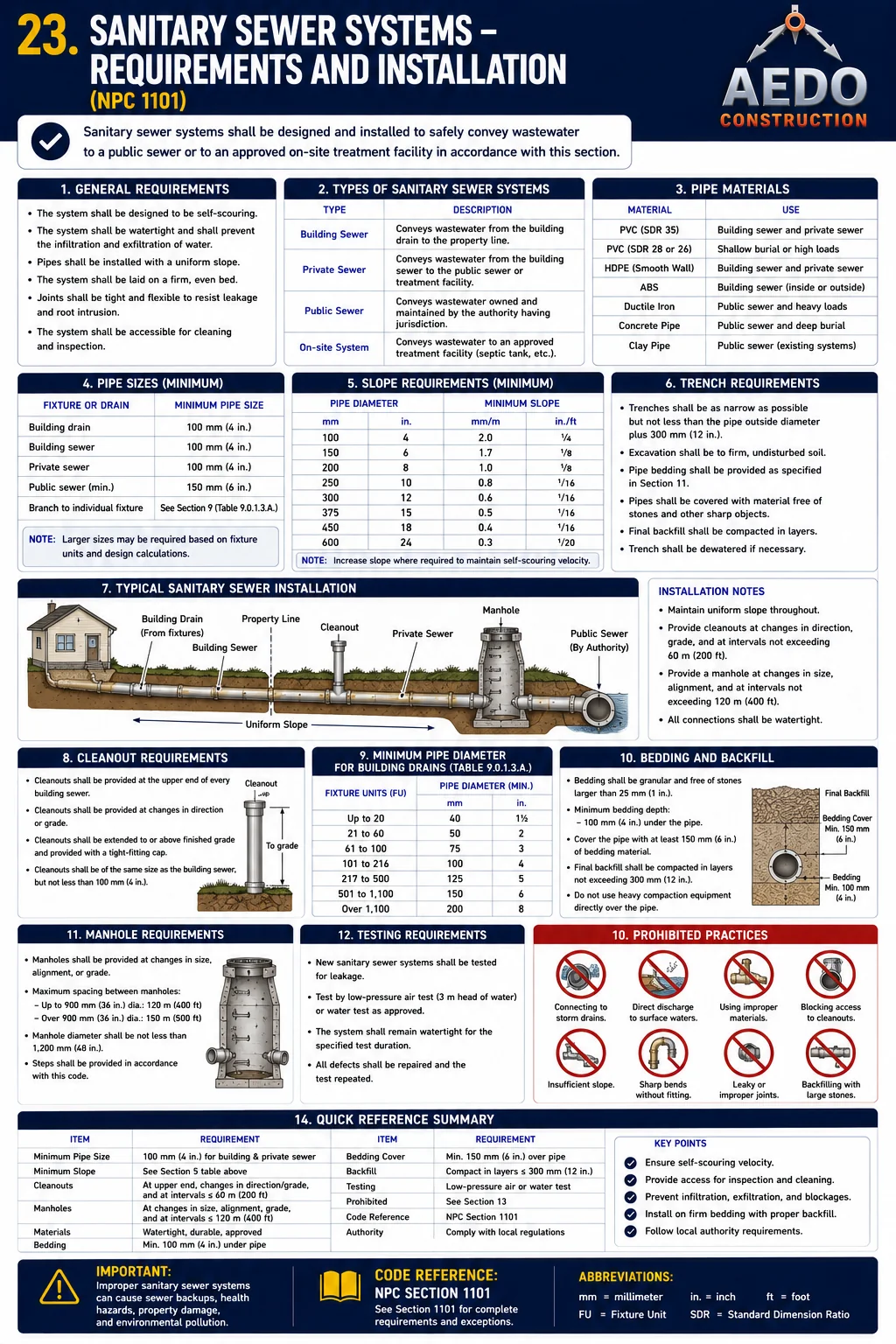
Sanitary (building) sewer — requirements & installation. The building sewer runs from 0.6 m outside the foundation to the public sewer or private disposal system, on a uniform 2% grade, minimum 150 mm diameter, with cleanouts every 15 m and at each aggregate change of direction exceeding 135°. Keep clearances per Table 12-1 and isolate from the potable water service per §1208. (NPC §1206–§1209)
Abandoned Sewers and Sewage Disposal Facilities
Capping disused sewers and filling abandoned disposal facilities
§1210.2 — An abandoned cesspool, septic tank, or seepage pit shall have its sewage removed and be completely filled with earth, sand, gravel, concrete, or other approved material.
§1210.3 — The top cover/arch shall be removed before filling; filling shall not extend above the top of the vertical sidewalls or outlet pipe level until inspected, then filled to the level of the finished ground.
§1210.4 — The owner or person in control must comply with the Department having jurisdiction.
§1210.5 — Where disposal facilities are abandoned because the building has connected to the public sewer, the permittee must fill all abandoned facilities as required by the Administrative Authority within thirty (30) days of connecting the sewer service line to the public sewer.
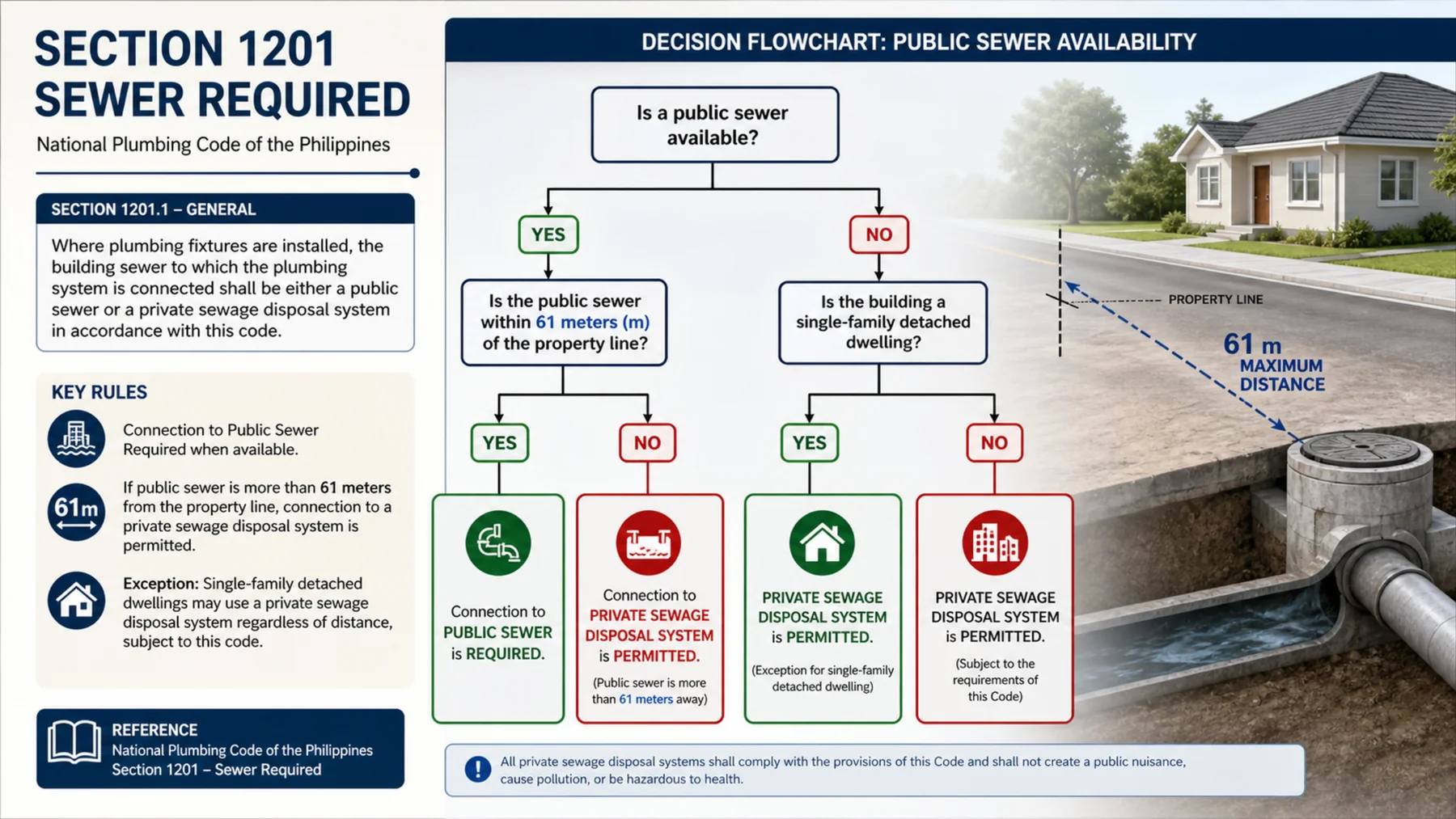
NPCP §1201 — Sewer required. Connection to the public sewer is required when one is available within 61 m of the property line; beyond that (or for single detached dwellings) a private sewage disposal system is permitted.
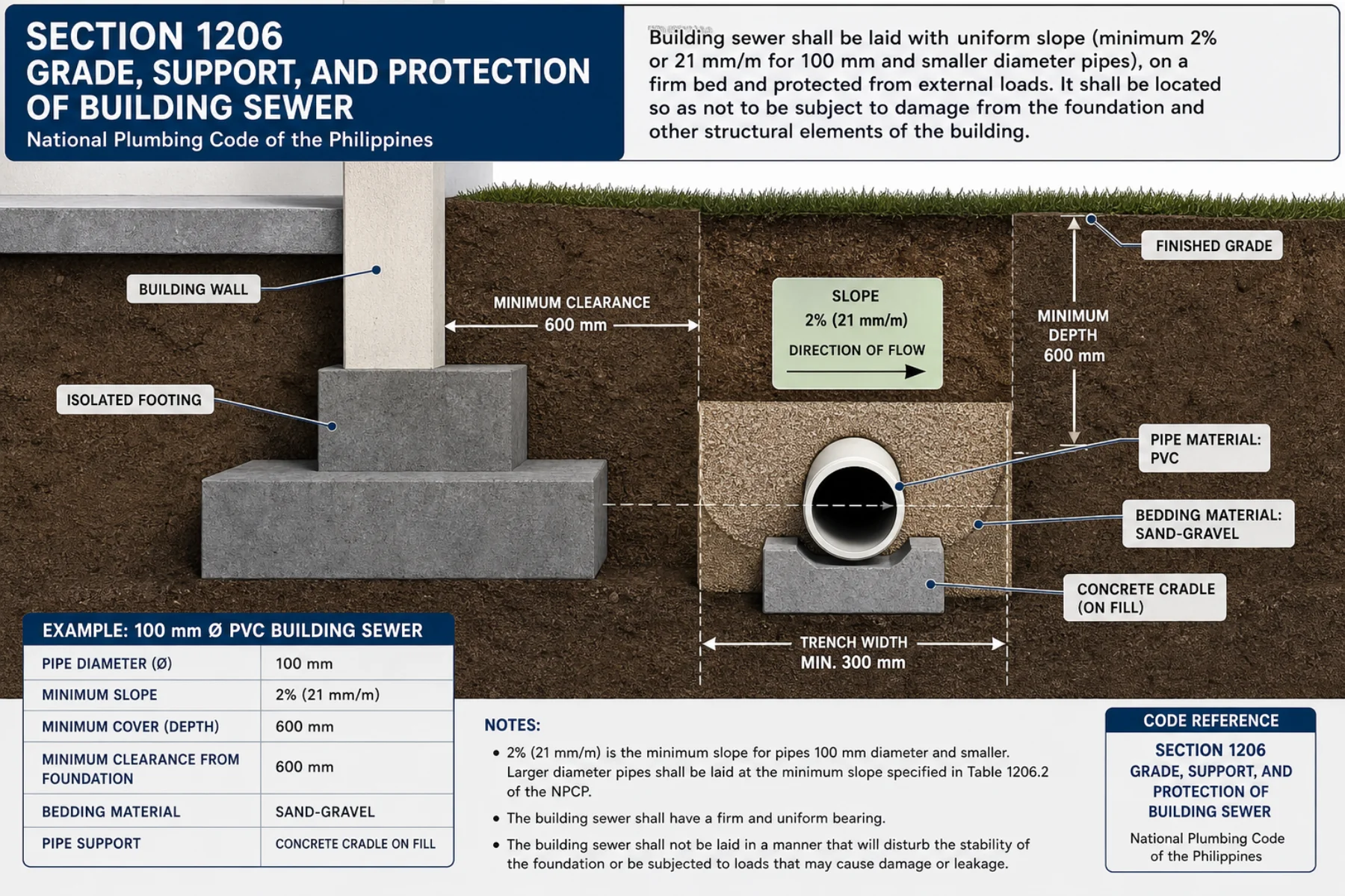
NPCP §1206 — Building sewer grade & support. Uniform slope of at least 2% (21 mm/m) for ≤100 mm pipe, ~600 mm minimum cover and clearance from footings, on a firm bed (sand-gravel / concrete cradle on fill).
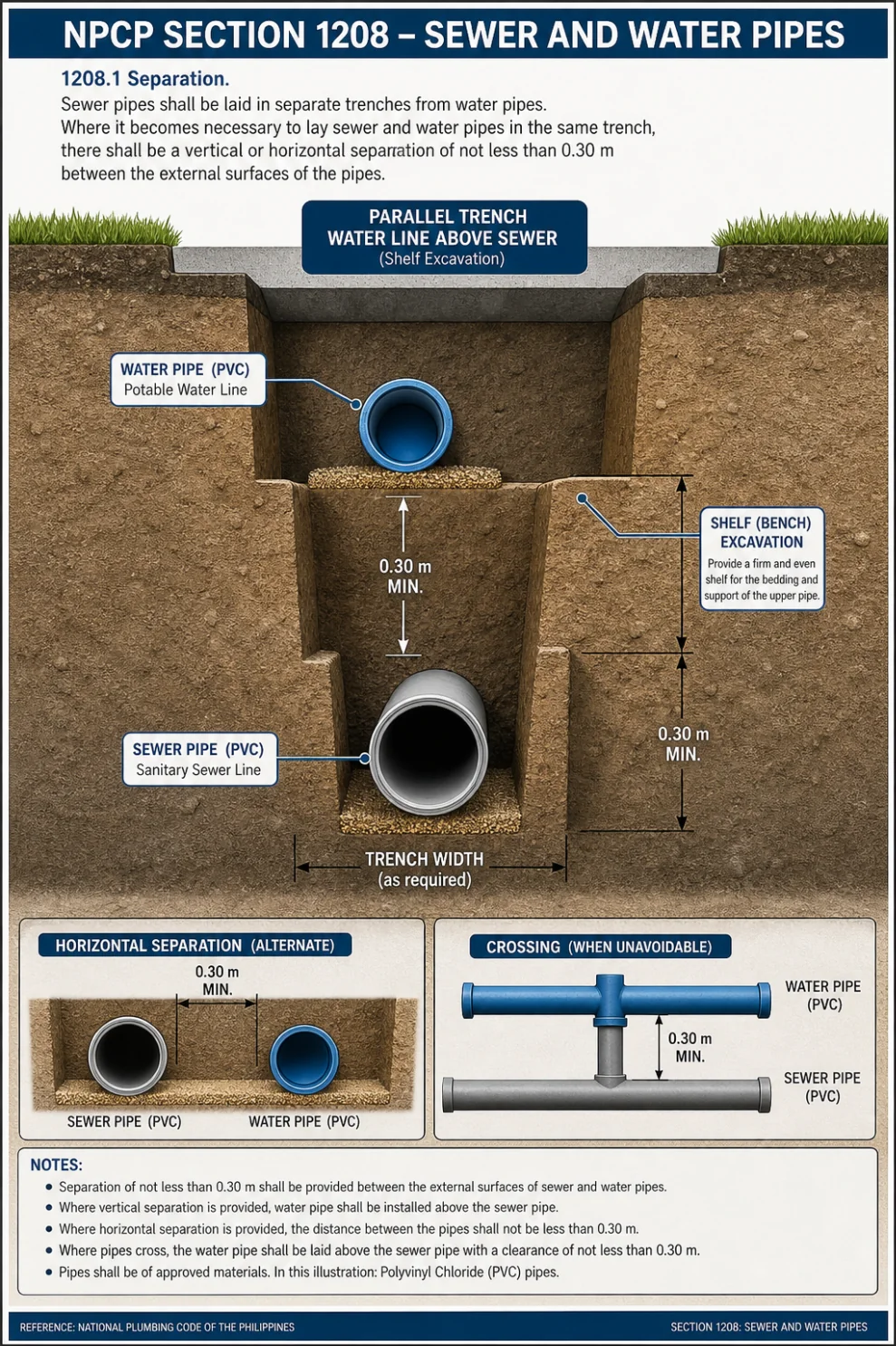
NPCP §1208 — Sewer & water pipe separation. Sewer and potable-water pipes in separate trenches; where in the same trench, keep at least 0.30 m separation with the water line benched above the sewer.
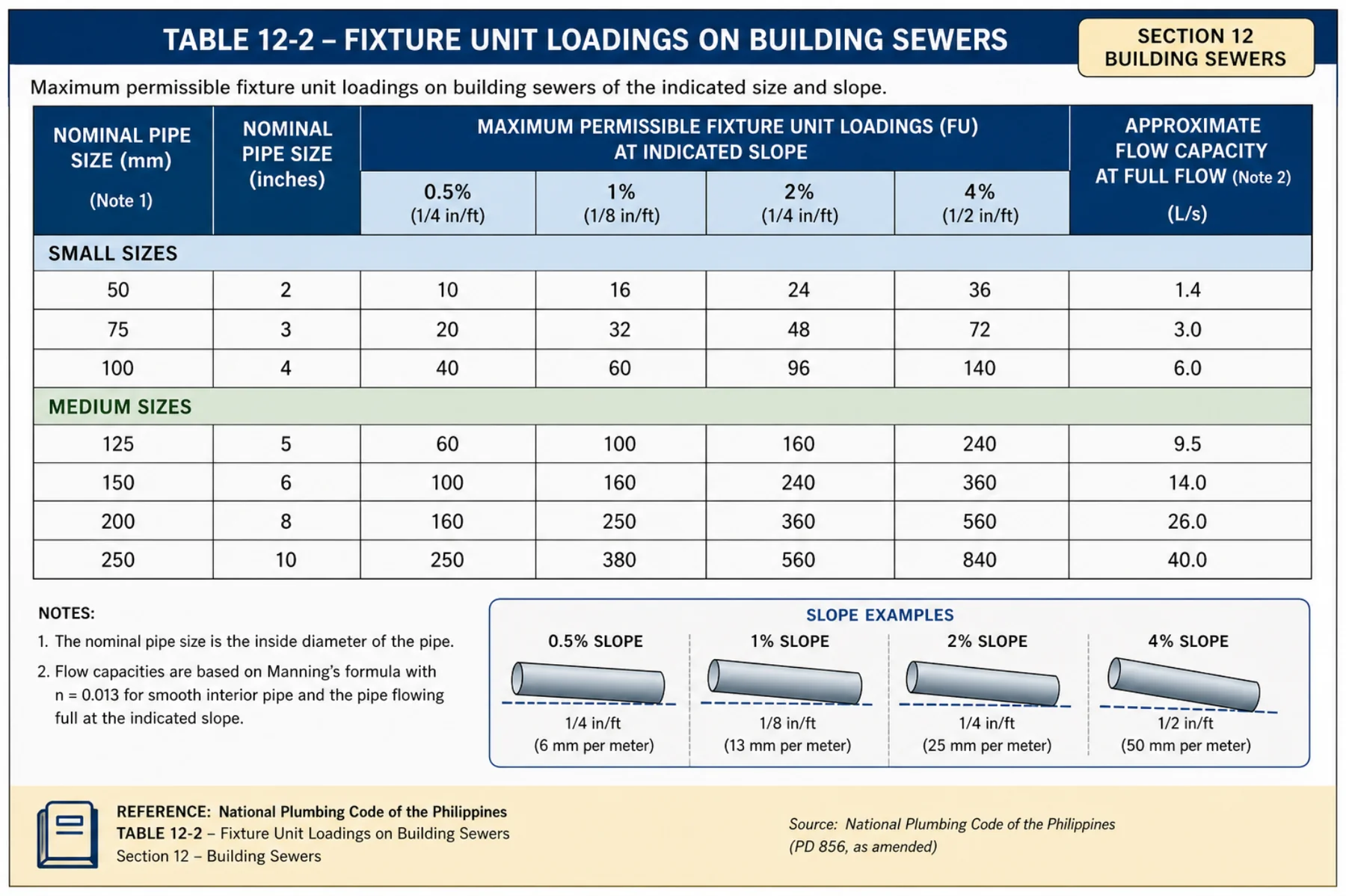
NPCP Table 12-2 — Building-sewer capacity. Maximum permissible fixture-unit loading on the building sewer by pipe size and slope (e.g. 100 mm at 2% → 96 FU; 150 mm → 240 FU), with approximate full-flow capacity in L/s.