
Vents & Venting
Chapter 9 governs the vent system — the network of pipes that keeps air pressure inside the drainage system equalized so that trap seals are never lost. Without venting, draining water creates a vacuum that siphons the water out of traps, allowing toxic sewer gas to enter the building. Key rules: every trap must be vented, the maximum trap-to-vent distance limits how far a trap arm can extend, and vent pipes must always slope back to drain — never trap water.
Why Venting is Required
The two failure modes that venting prevents
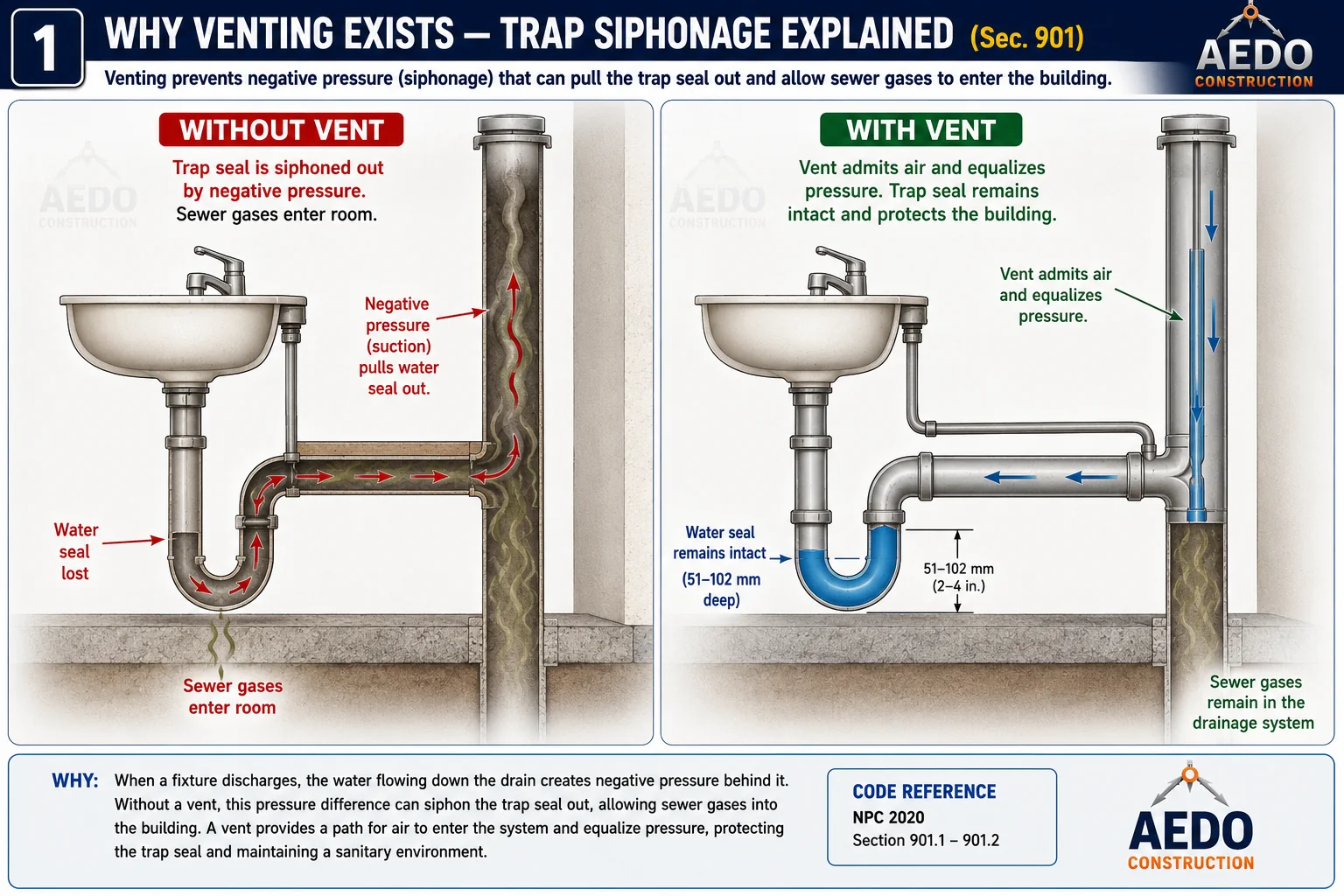
Why venting exists — trap siphonage. Without a vent (left), fast drain flow creates negative pressure behind the falling water that siphons the trap seal out, letting sewer gas enter the room. With a vent (right), air is admitted to equalise the pressure, the trap seal holds, and gas is blocked. (NPC §901)
Occurs when the drain flow velocity is high enough to create a vacuum in the trap arm, sucking the water seal out of the trap. Most common in long unvented trap arms.
Occurs when heavy flow in the stack compresses the air ahead of it, creating a positive pressure surge that blows gas bubbles through lower-floor traps.
Vent Pipe Grade and Draining
Vent pipes must slope to drain — water in a vent causes blockage
| Vent Pipe Orientation | Required Slope Direction | Notes |
|---|---|---|
| Horizontal vent run (near fixture) | Slope back toward drain — minimum 1% (10mm/m) | Condensation and splashback must drain away |
| Horizontal vent run (above flood level) | Slope toward vent stack — 1% minimum | After rising above flood rim, drain toward stack |
| Horizontal vent at roof | Slope toward interior — drain back into building vent system | Prevents rain water entry into vent system |
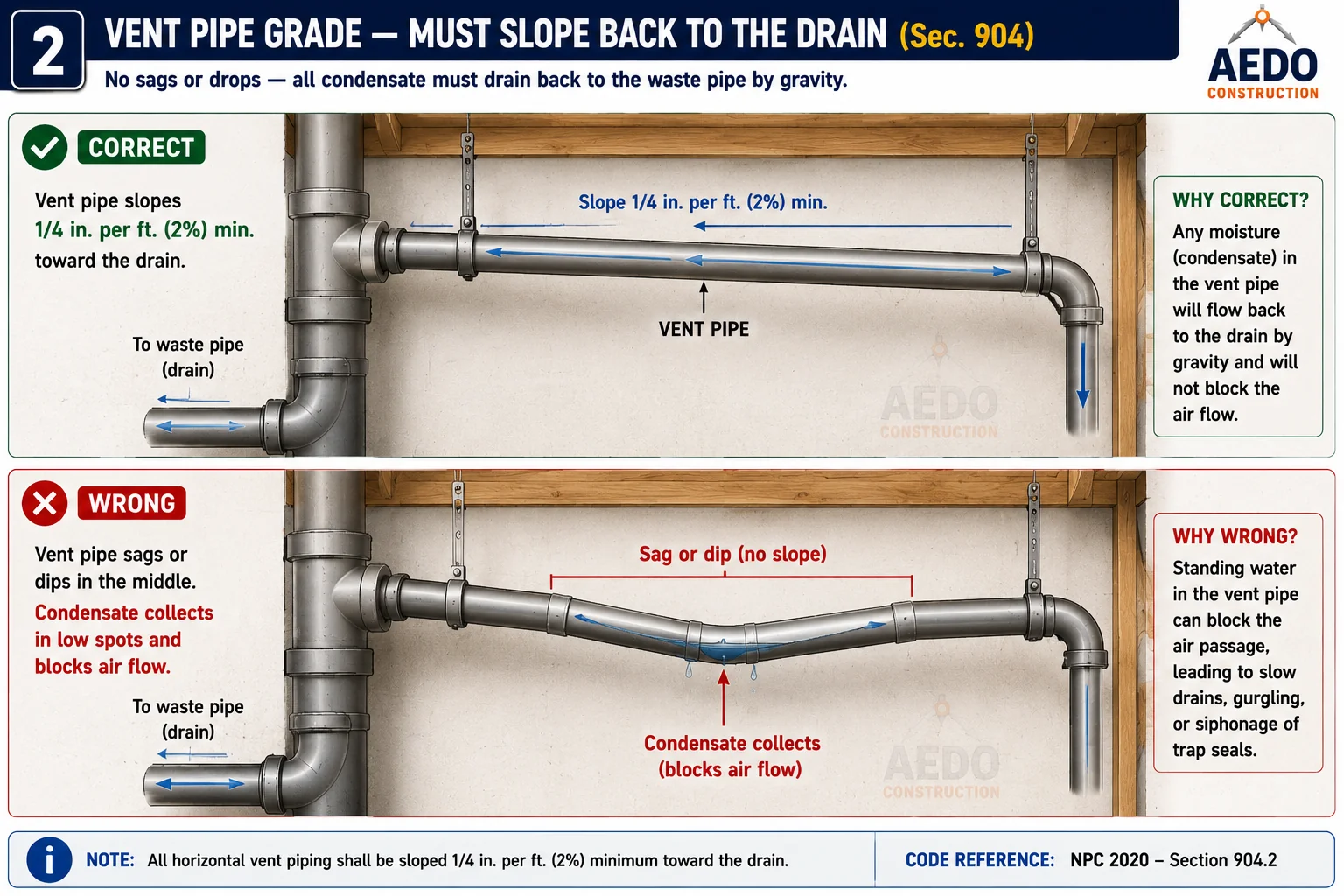
Vent pipe grade — must slope back to the drain. Correct: the vent slopes back ¼″ per ft (≈2%, 21 mm/m) toward the waste pipe so any condensate drains by gravity. Wrong: a sag or dip in the run lets condensate collect and block the vent. (NPC §904)
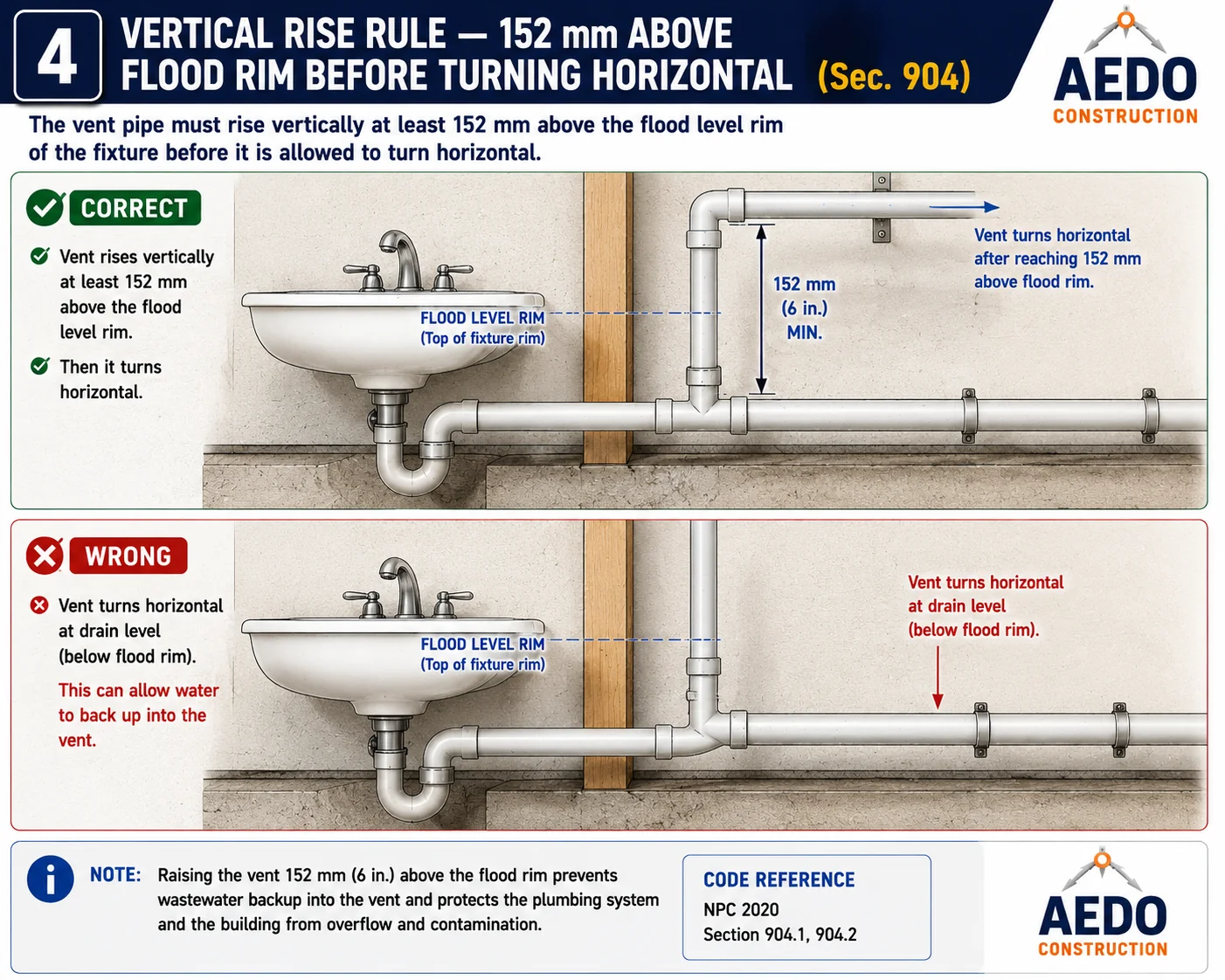
Vertical rise rule. A vent must rise vertically to at least 152 mm (6″) above the flood-level rim of the fixture it serves before it is allowed to turn horizontal — protecting the vent from waste backup and contamination. (NPC §904)
Types of Vents
The five vent configurations and when each is used
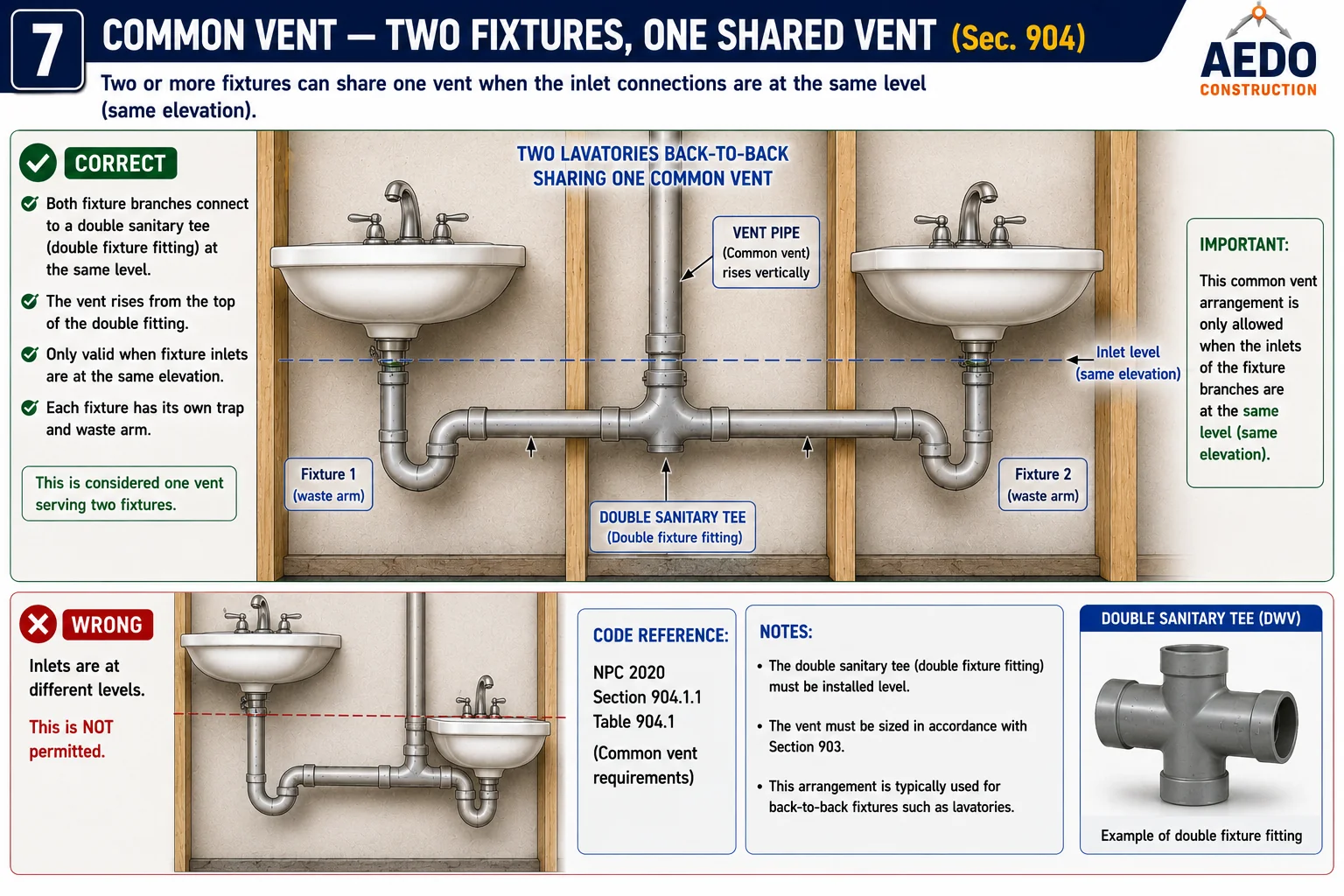
Common vent — two fixtures, one shared vent. Two fixtures at the same floor level may share a single vent where their drains connect to the stack at the same point (e.g., back-to-back lavatories). Both must be on the same level; fixtures at different levels may not share a common vent this way. (NPC §904)
| Vent Type | Description | When Used | Key Limit |
|---|---|---|---|
| Individual Vent | A vent pipe serving a single trap | Always acceptable; required when no other type qualifies | Must connect at or above trap weir level |
| Common Vent | Single vent shared by two traps at the same floor level connecting back-to-back on opposite sides of a stack | Lavatories, sinks on both sides of a wall | Both traps must be on the same floor; connect at the same point on the stack |
| Wet Vent | A drain pipe that simultaneously serves as a vent for an upstream fixture | Lavatory upstream of a WC on the same branch | Max 4 DFU on wet-vented branch; wet vent pipe sized 1 size larger than drain alone would require |
| Circuit Vent | A single vent at the upstream end of a horizontal branch serving 2–8 fixtures on that branch | Public toilet rooms with multiple WCs on one branch | Max 8 fixture trap arms on the circuit; requires relief vent at downstream end |
| Loop Vent | A circuit vent that also connects back to the main vent stack at the top | Long horizontal branches with many fixtures | Similar limits to circuit vent; superior air circulation |
Maximum Distance — Trap to Vent
Table 10-1 (NPC Chapter 10) — Critical limits on trap arm length
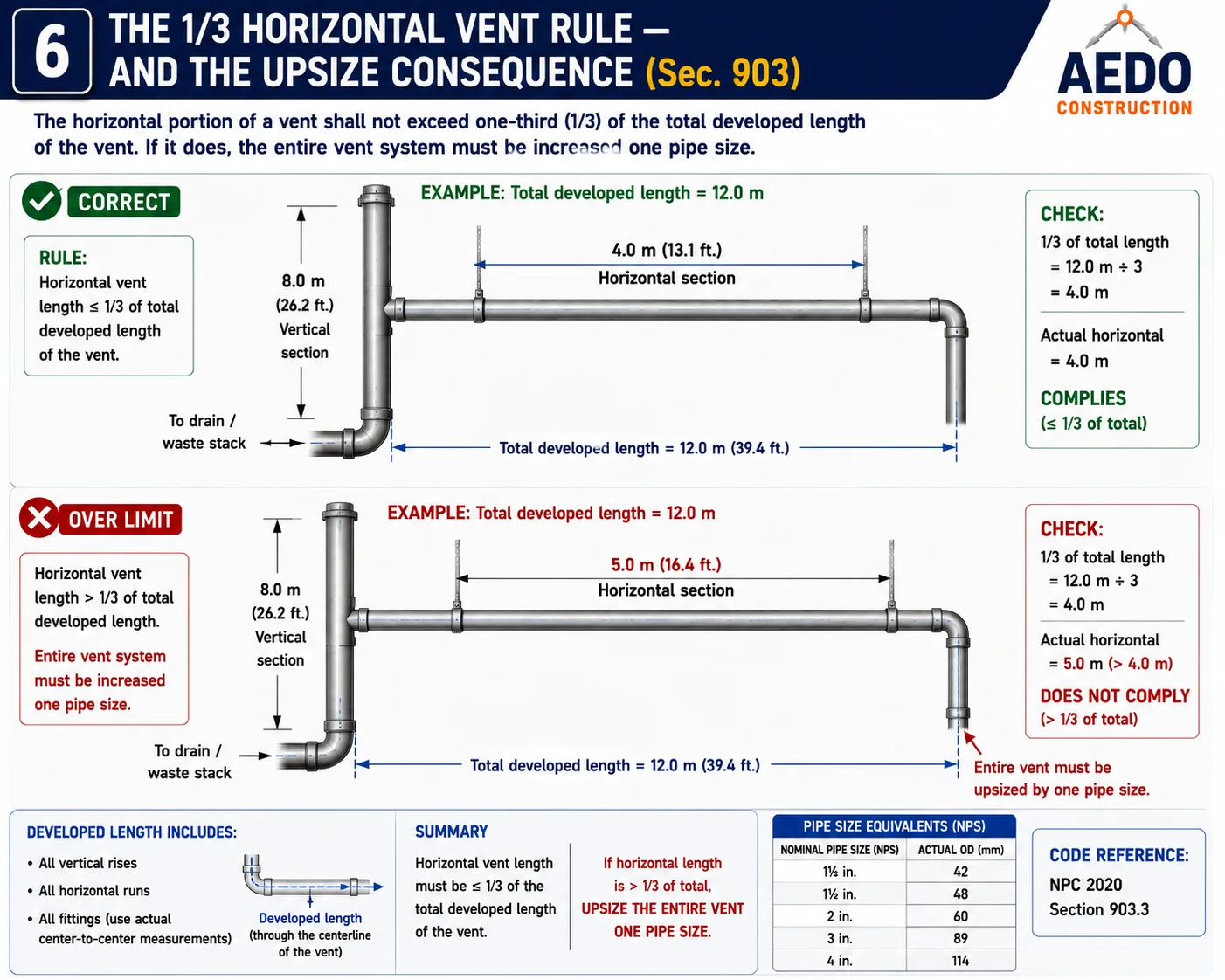
The ⅓ horizontal vent rule. The horizontal portion of a vent shall not exceed one-third (⅓) of the total developed length of that vent. If it does, the entire vent must be upsized one pipe size. This keeps the trap arm / horizontal run short enough to avoid siphonage. (NPC §903)
| Trap Arm Pipe Size | Max Distance (Trap Weir to Vent) | Equivalent |
|---|---|---|
| 32 mm (1¼") — Lavatory, bidet | 760 mm | 0.76 m |
| 38 mm (1½") — Bathtub, kitchen sink | 1,070 mm | 1.07 m |
| 51 mm (2") — Shower, laundry | 1,520 mm | 1.52 m |
| 76 mm (3") | 1,830 mm | 1.83 m |
| 102 mm (4") — WC | 3,050 mm | 3.05 m |
Values per NPC Table 10-1 (max developed length of trap arm at 2% slope). The trap arm must also be at least 2× the pipe diameter long, and a water closet's developed distance (flange to vent) must not exceed 1.8 m.
Vent Pipe Sizing
Derived from NPC Table 7-5 (Ch. 7) — Vent diameter based on DFU load and developed length. Not an officially numbered Chapter 9 table; vent sizing is governed by Table 7-5, p.88.
| Vent Pipe Diameter | Max DFU Served | Max Developed Length (m) | Typical Fixture |
|---|---|---|---|
| 32 mm (1¼") | 1 | 9 | Single lavatory or bidet |
| 38 mm (1½") | 8 | 15 | Bathtub + lavatory combination |
| 50 mm (2") | 24 | 46 | Small bathroom group |
| 75 mm (3") | 72 | 91 | Toilet room (multiple WCs) |
| 100 mm (4") | 400 | 274 | Large vent stack / building vent |
| 125 mm (5") | 1,100 | 381 | Large building vent stack |
| 150 mm (6") | 2,000 | 457 | High-rise vent stack |
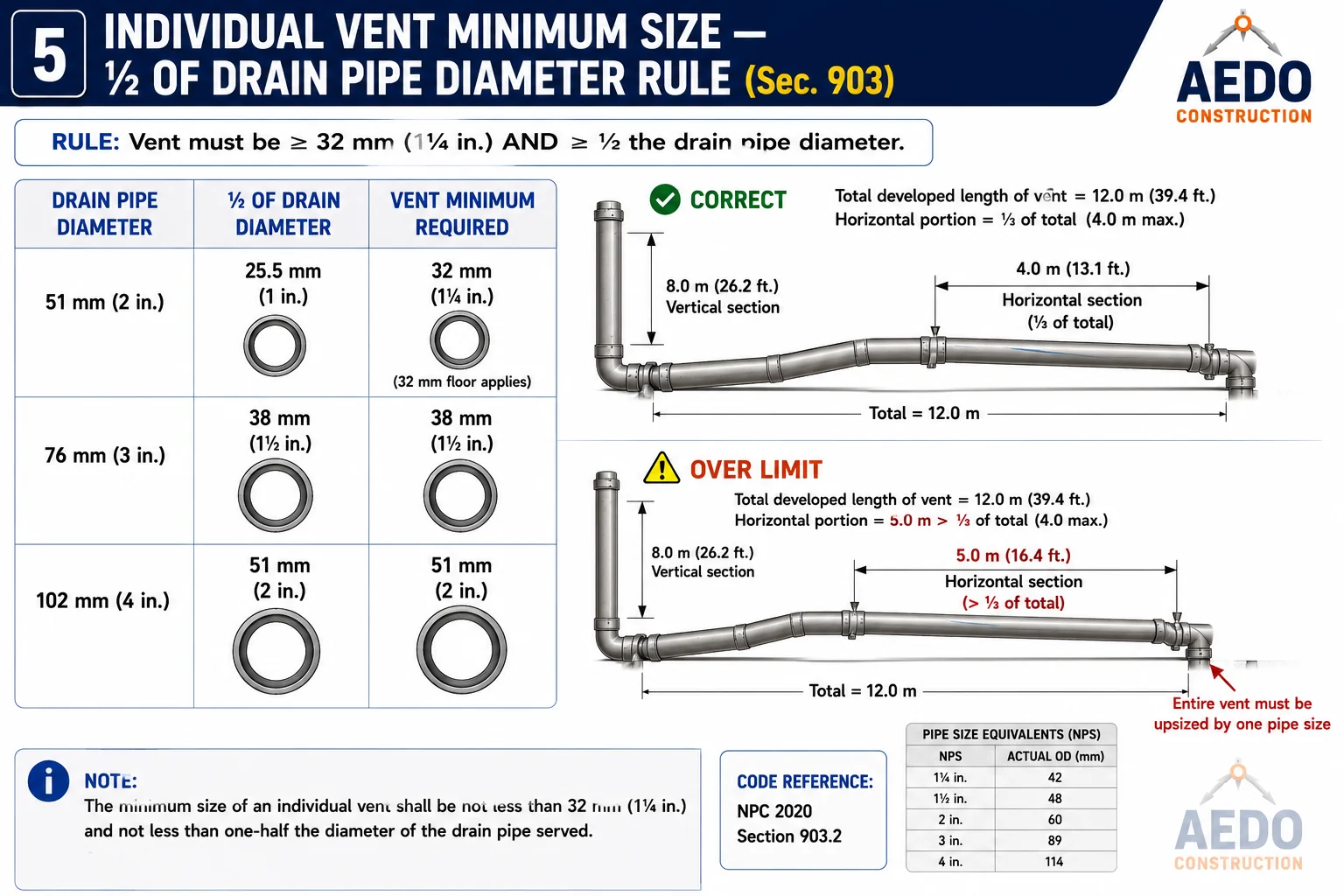
Individual vent minimum size. A vent must be at least 32 mm (1¼″) and not less than ½ the diameter of the drain it serves. Examples: 51 mm drain → 25.4 mm min vent; 76 mm drain → 38 mm; 102 mm drain → 51 mm. (NPC §903)
Vent Connection Location
Where vent pipes connect to drains and stacks
| Connection Point | Requirement | Why |
|---|---|---|
| Vent to horizontal drain branch | Connect above the centerline of the drain pipe — minimum at the 12 o'clock position | Prevents drain waste from flowing into vent pipe during peak flow |
| Vent to drain stack | Connect above the highest fixture drain branch at that floor level | Keeps vent clear of waste flow in stack |
| Vent from trap arm | Connect within the maximum trap arm distance (Table 10-1) — measured from trap weir | Closer is better; prevents siphonage |
| Vent at base of drain stack | No vent connection within 3× the stack diameter above the base bend | Turbulent flow zone — vent would be flooded |
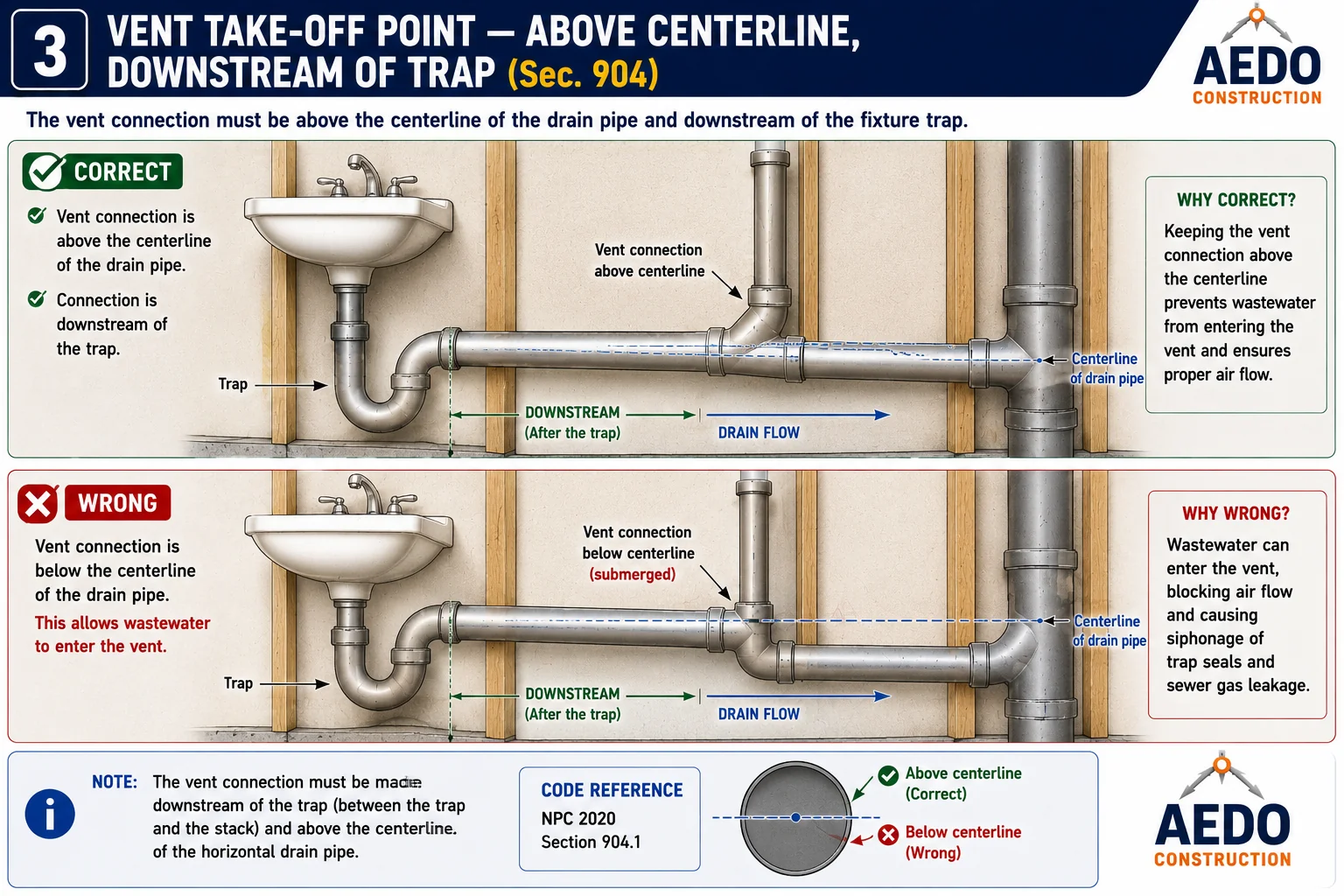
Vent take-off point. The vent must connect to the drain above the centerline of the pipe and downstream of the fixture trap. Taking the vent off below the centerline lets waste flow into and foul the vent line. (NPC §904)
Vent Terminals (Roof Penetrations)
Where and how vent pipes terminate above the roof
| Condition | Minimum Height Above Roof | Notes |
|---|---|---|
| Standard roof (not occupied) | 150 mm (6") | Clear of snow accumulation and standing water |
| Occupied roof / roof terrace / roof deck | 300 mm (12") | People may be present; higher clearance required |
| Near door, window, or air intake (within 3m horizontally) | 600 mm above the opening | Sewer gas must not re-enter building through openings |
| Near air intake (HVAC, mechanical) | Terminate at least 3m away horizontally, or 600mm above | Sewer gas must not enter air handling system |
| Cold climates / frost protection | Minimum 75mm diameter at roof penetration | Smaller pipes can frost-close in cold weather |
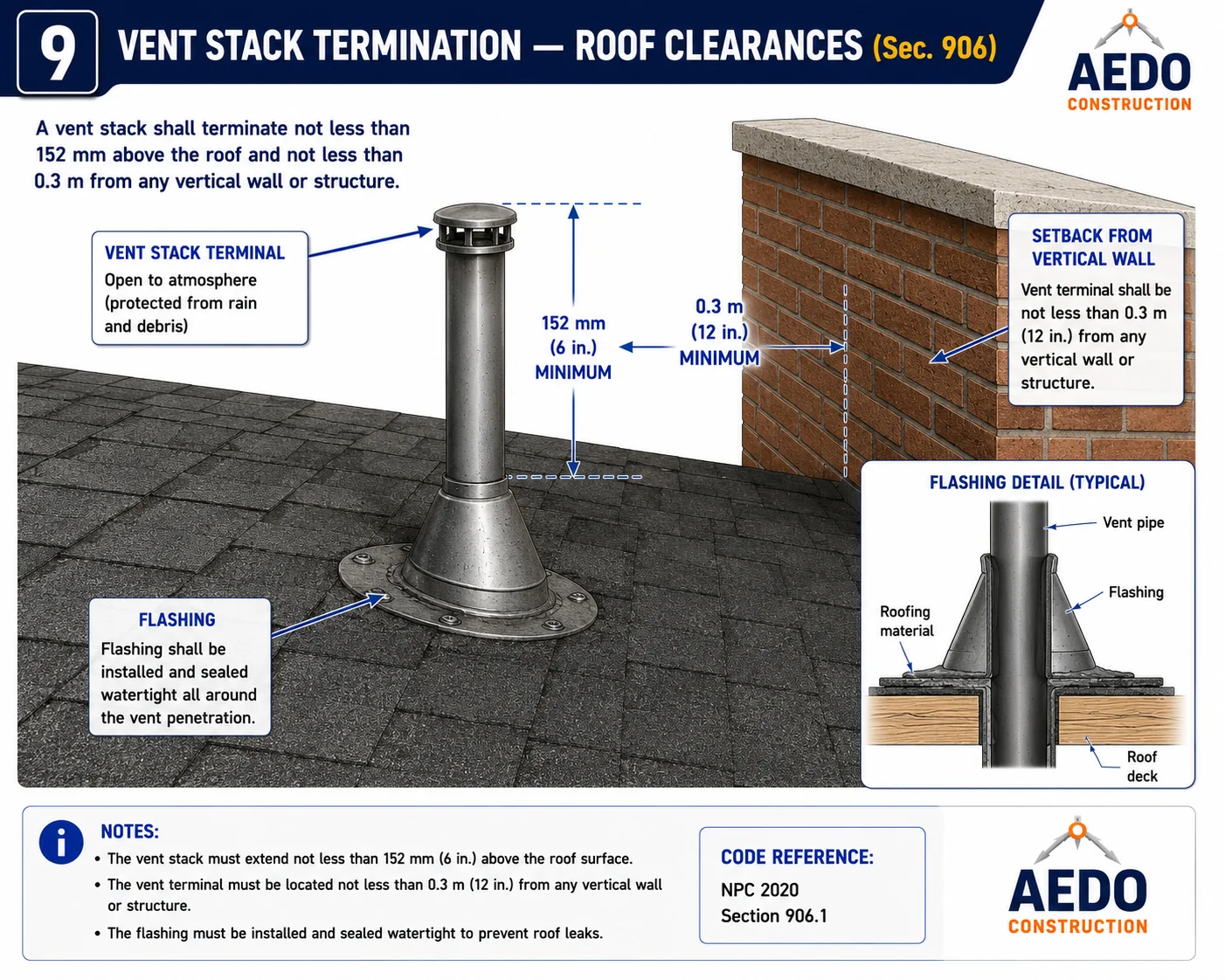
Vent stack termination — roof clearances. An open vent must extend at least 152 mm (6″) above the roof and at least 0.3 m from any vertical wall or structure, with a properly sealed, watertight flashing collar at the penetration. (NPC §906)
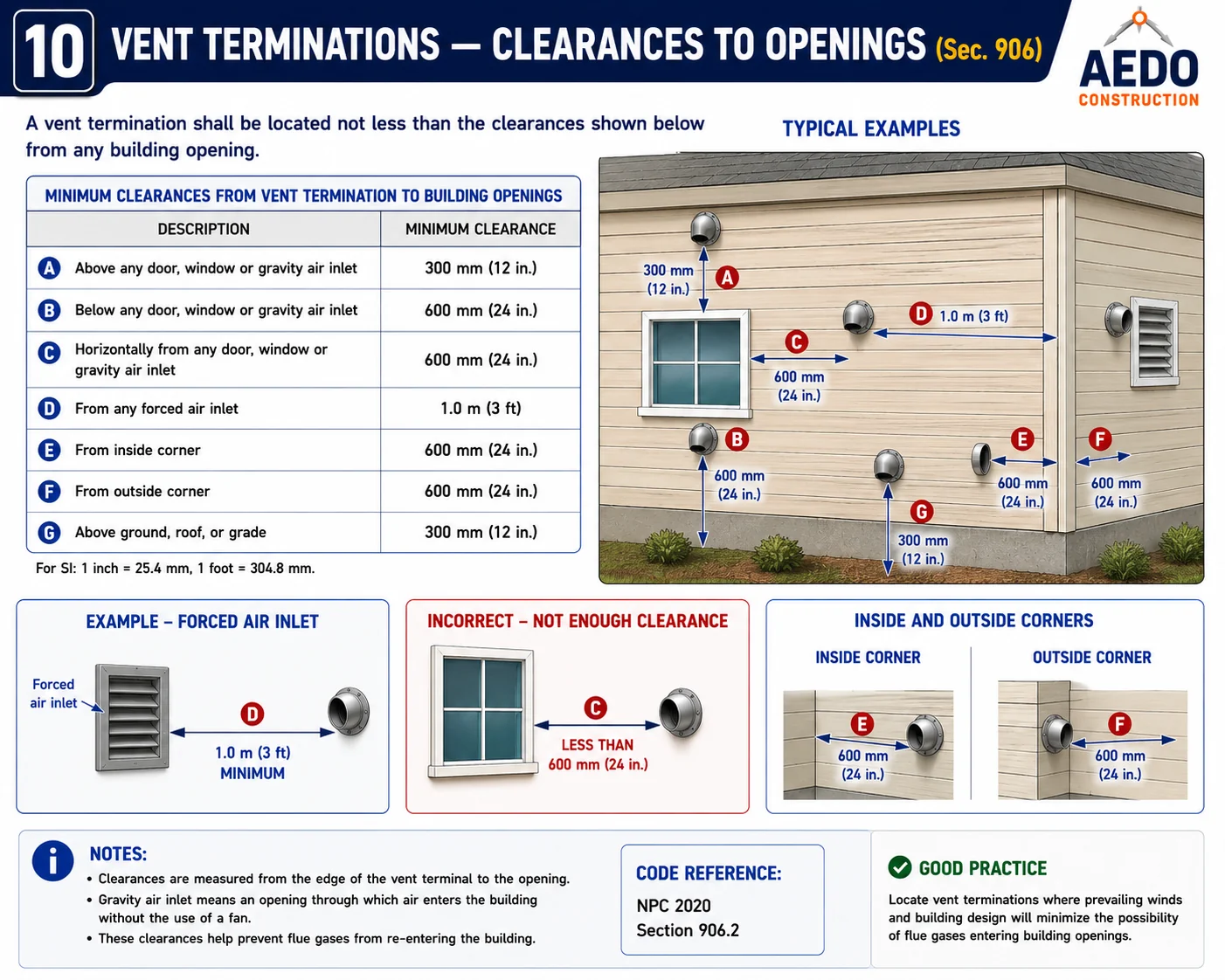
Clearances to openings. A vent termination must be at least 0.9 m (3′) above, or 3 m (10′) horizontally from, any door, openable window, or air intake — so sewer gas cannot re-enter the building. (NPC §906)
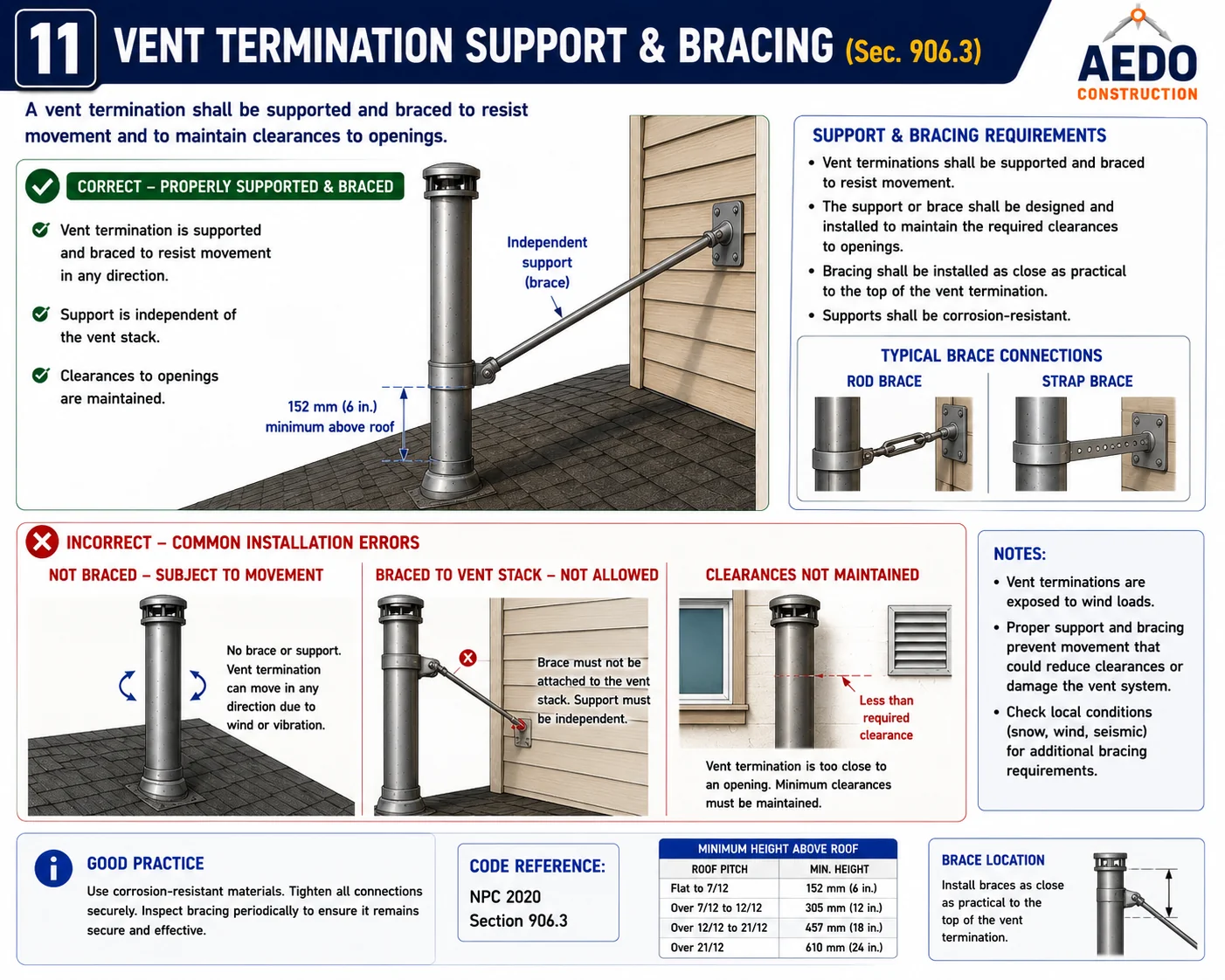
Support & bracing. A vent termination must be independently supported and braced to resist wind and snow movement — never relying on the flashing alone. Use approved brace connections and keep the penetration watertight. (NPC §906.3)
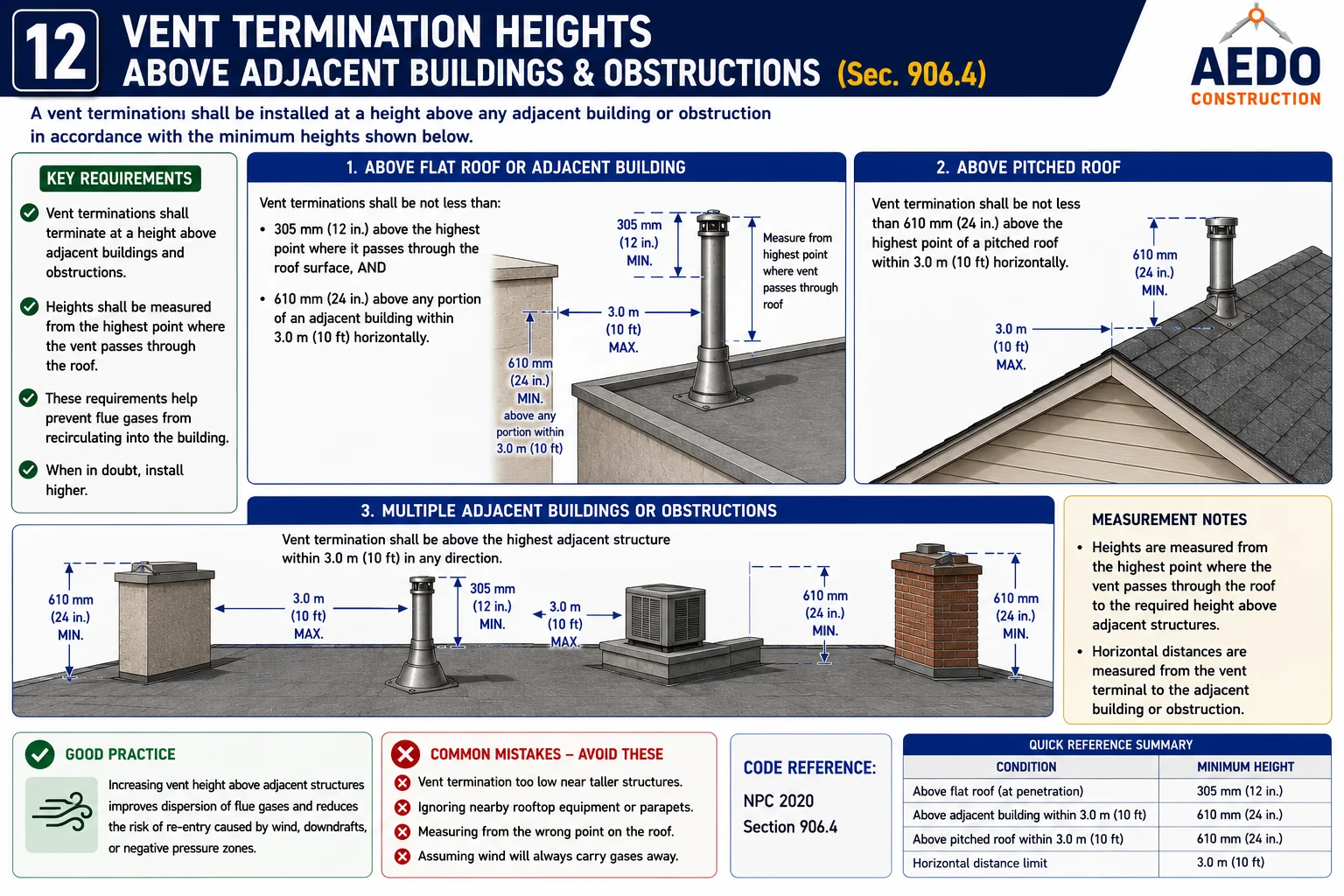
Heights above adjacent buildings & obstructions. Where a vent terminates near a taller wall or adjacent building, raise the terminal so gases discharge clear of the obstruction and cannot pocket against it. (NPC §906.4)
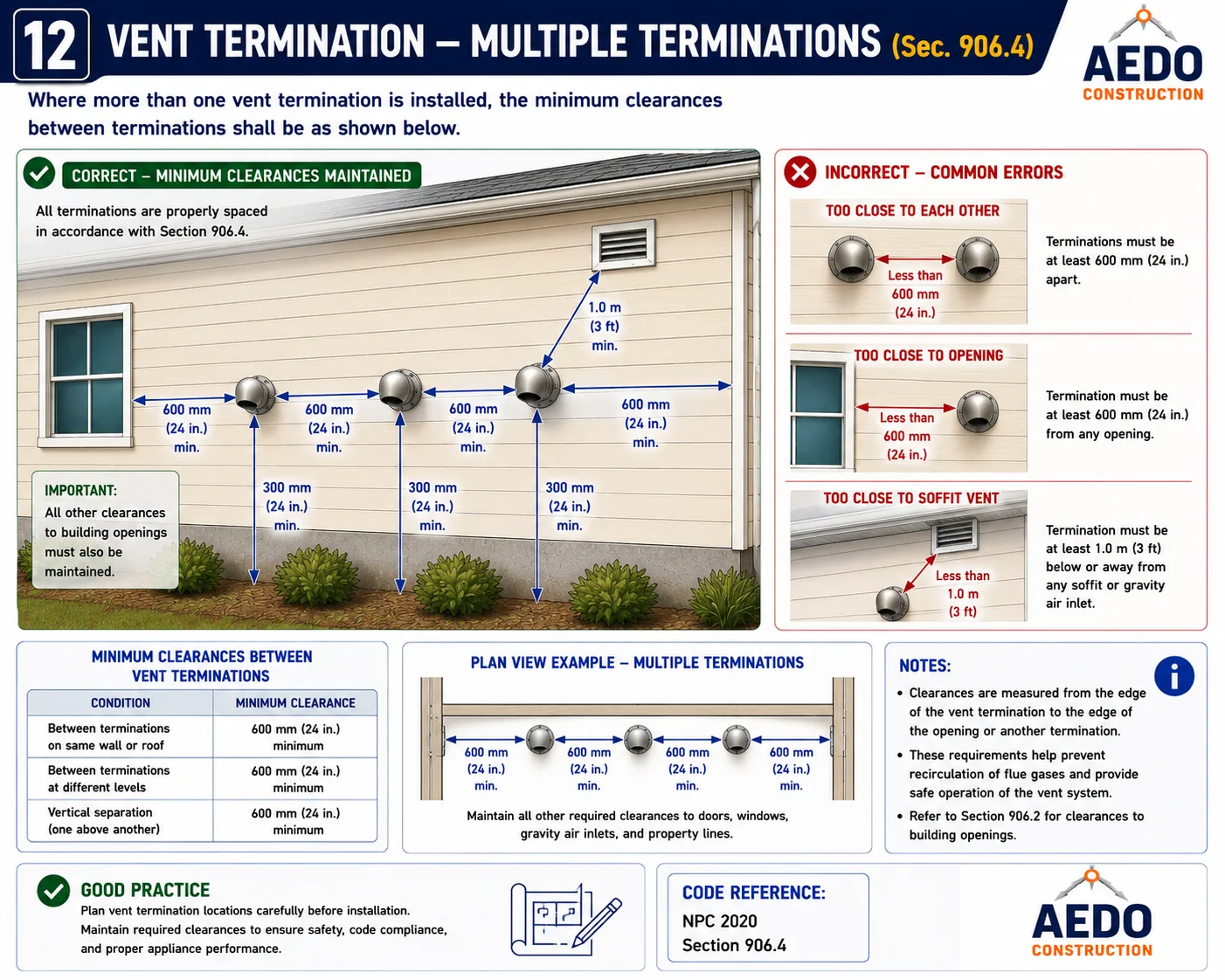
Multiple terminations. Where several vents terminate close together, maintain the minimum clearances between terminations shown on the plan so each discharges freely. (NPC §906.4)
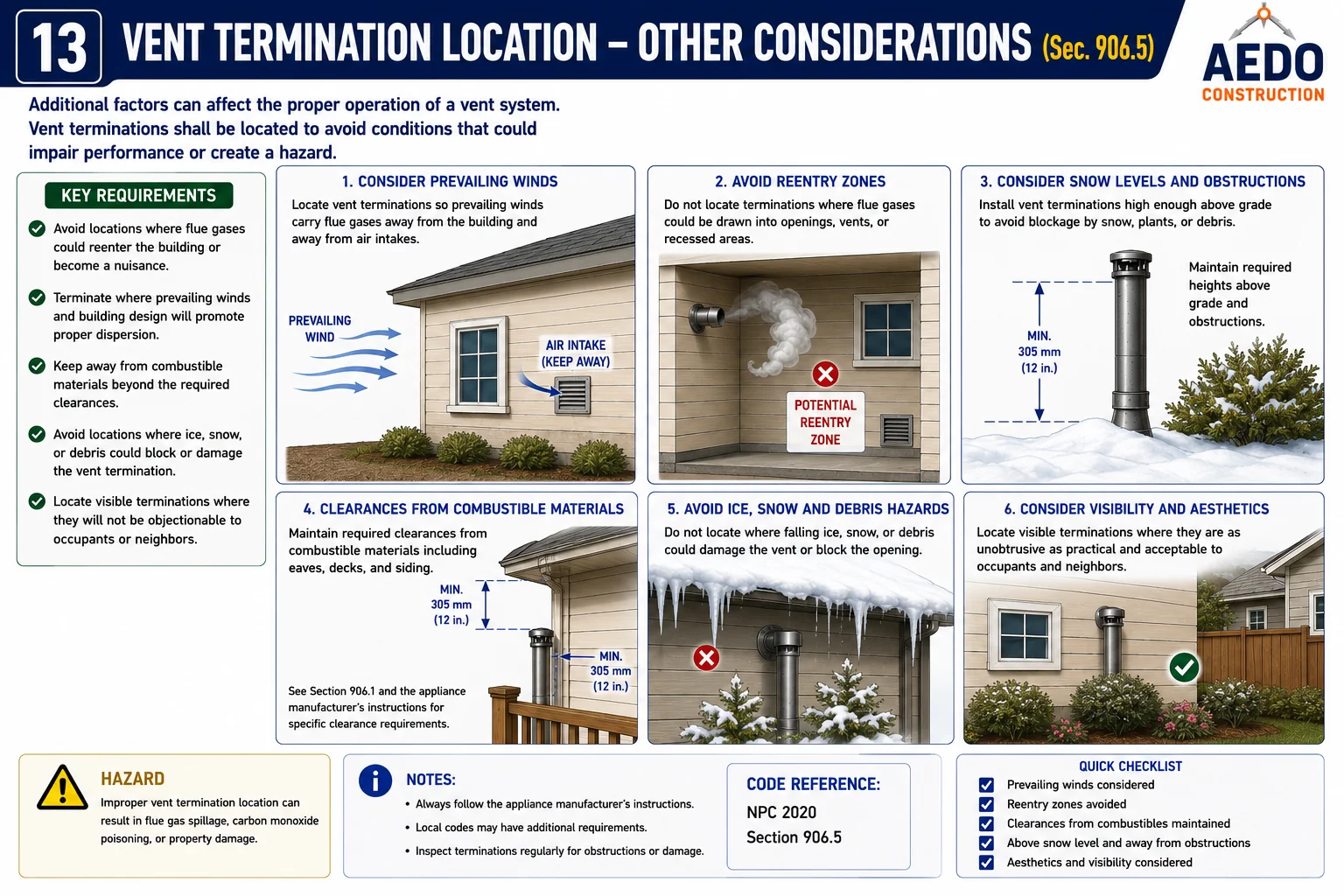
Location — other considerations. Avoid placements that recirculate flue/sewer gases or sit in confined spaces; keep terminations clear of building features and follow good-practice placement. (NPC §906.6)
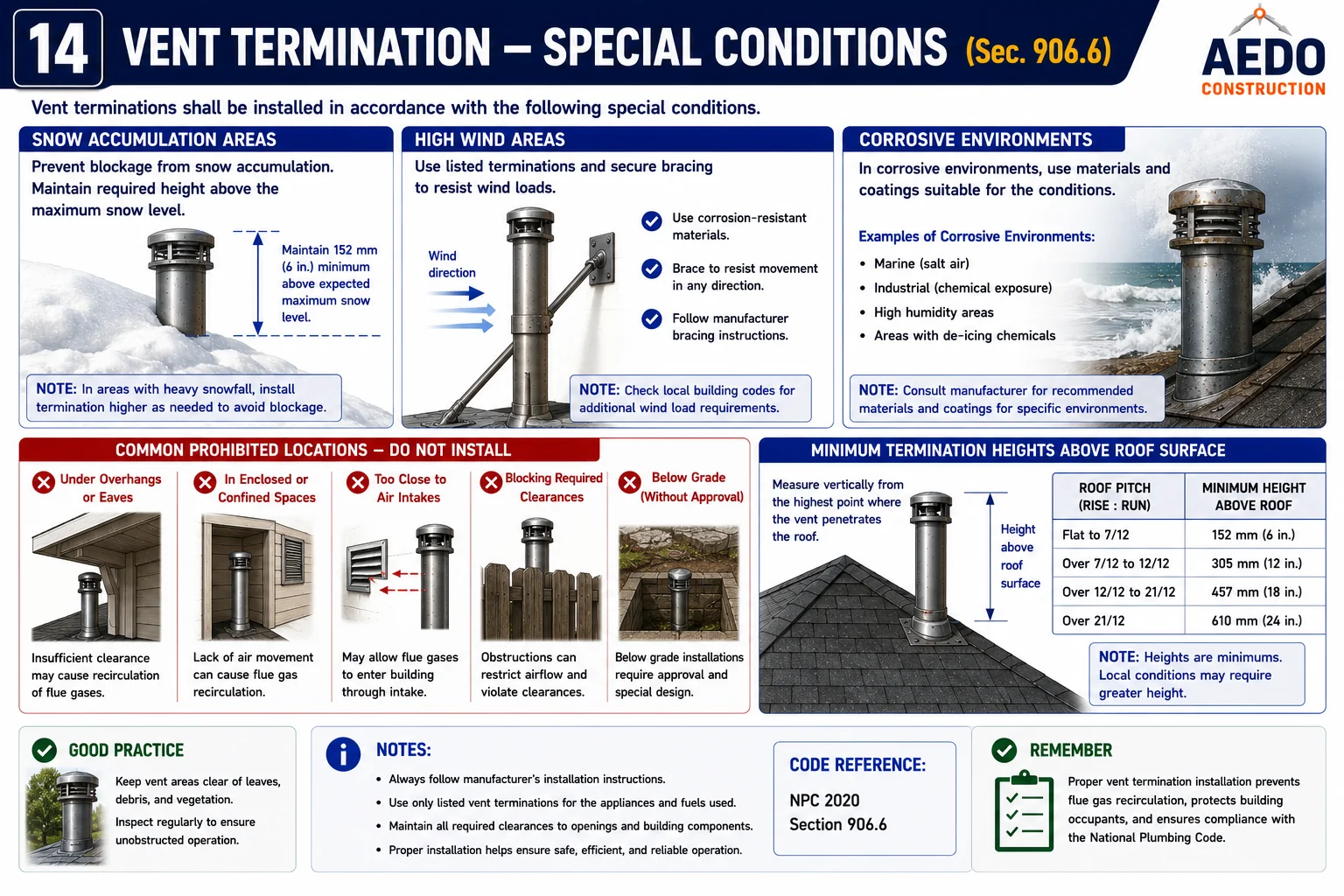
Special conditions. Snow areas — raise above the maximum snow level. High-wind areas — corrosion-resistant material, braced. Corrosive environments (marine, chemical, de-icing) — suitable materials/coatings. Do not terminate under eaves, in confined spaces, near air intakes, or below grade. Minimum height above roof increases with roof pitch (152 mm flat → up to 610 mm over 21/12). (NPC §906.6)
Air Admittance Valves (AAV)
Mechanical alternative to piped vent — conditions and limitations
AAV — Permitted Uses
- Individual fixture venting (lavatory, shower, sink) where a vent pipe through the roof is impractical
- Island sink venting — no wall to route vent pipe up through
- Renovation projects where wall framing prohibits running a vent pipe
- Fixture additions on existing branches where extending the main vent is cost-prohibitive
AAV — Prohibited Uses
- As the sole vent for a building — at least one vent pipe must terminate through the roof
- In inaccessible locations — must be reachable for inspection/replacement
- In airtight chase or cavity without air supply to the valve
- Below grade or inside wall cavities without access panel
- As a vent for a wet vent system (wet vents need open-air termination)
| AAV Requirement | Specification |
|---|---|
| Approved standard | ASSE 1051 (individual fixture) or ASSE 1050 (stack type) |
| Minimum height above trap arm | 150mm above the trap arm connection — must be in accessible space |
| Access requirement | Must be accessible without removing permanent construction (access panel required in walls/ceilings) |
| Replacement | AAV is a mechanical device with finite lifespan — shall be replaced when it no longer opens/closes properly (typically 500,000 cycles) |
| Size | Same diameter as the vent pipe it replaces — never smaller |
Yoke Vents (High-Rise Buildings)
Required when stacks serve 10 or more branch intervals
In a tall building, heavy simultaneous drainage from multiple floors creates extreme pressure differentials in the stack. A yoke vent interconnects the soil/waste stack (which carries drainage and is under pressure) with the parallel vent stack (which carries only air) — relieving positive pressure build-up at each 5-floor zone and admitting air where a vacuum forms.
| Yoke / Relief Vent Requirement | Specification |
|---|---|
| Parallel vent stack required when | Soil/waste stack extends 10 or more stories above the building drain |
| Yoke vents located at | Ground level and at every 5th floor |
| Yoke vent size | Equal to the diameter of the soil stack or the vent stack, whichever is smaller |
| Connection — to vent stack | At least 1.0 m above the floor line |
| Connection — to drainage stack | Via a wye-branch fitting below the fixture branch for that floor |
| Purpose | Relieves positive pressure in the soil stack; lets excess air in the vent stack pass to the soil stack |
Stack Vent and Vent Stack
Two different pipe types — do not confuse them
The extension of the soil or waste stack above the highest horizontal drain branch on that stack. It carries both air and potential condensation. Terminates through the roof. Every stack has a stack vent.
A separate, parallel vertical pipe installed alongside the soil stack — carries only air (no drainage). Connected to the soil stack at the base and at yoke vent intervals. Required only for tall buildings (≥ 10 branch intervals).
High-rise buildings (≥ 10 floors): Both a stack vent and a separate vent stack are required, connected by yoke vents every 10 floors.
Wet Venting
Rules for combining drain and vent functions in a single pipe
| Wet Vent Rule | Requirement |
|---|---|
| Maximum DFU on wet-vented branch | 4 DFU maximum (equivalent to 1 WC + 1 lavatory + 1 bathtub) |
| Pipe size | Wet vent pipe shall be one pipe size larger than required for drainage alone |
| Typical wet vent size | 50mm wet vent where 38mm drain would otherwise suffice |
| Fixture served | Lavatory, bathtub, or shower may wet-vent a WC — but the WC cannot wet-vent anything |
| Vent portion still required | The upstream fixture (e.g. lavatory) still needs an individual vent or AAV from its own trap arm |
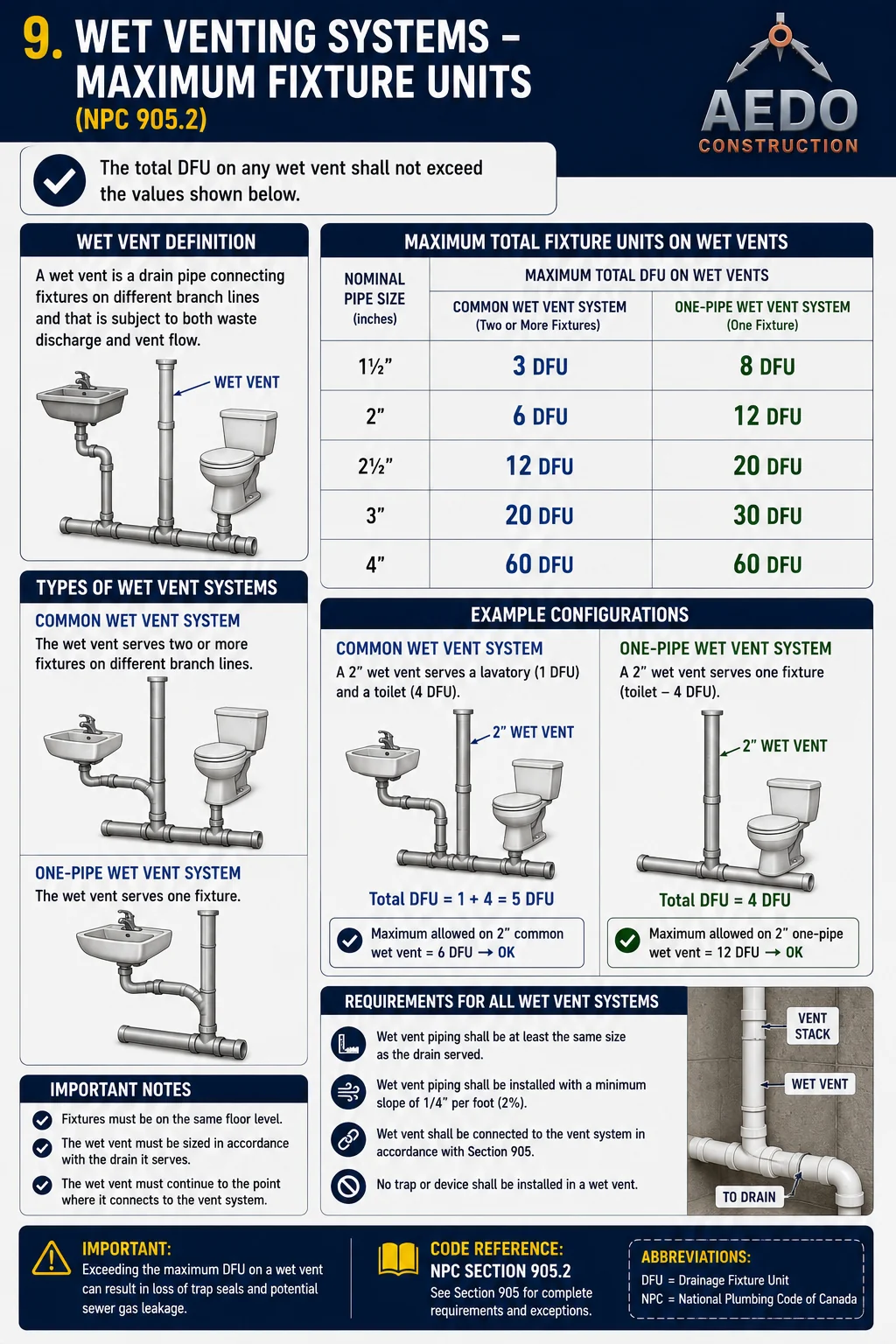
Wet vent maximum DFU limits by pipe size: 1½" = 3 DFU (common) / 8 DFU (one-pipe); 2" = 6 DFU / 12 DFU; 2½" = 12 DFU / 20 DFU; 3" = 20 DFU / 30 DFU; 4" = 60 DFU / 60 DFU. Fixtures must be on the same floor level. The wet vent must continue to the point where it connects to the vent system. No trap or device shall be installed in a wet vent.
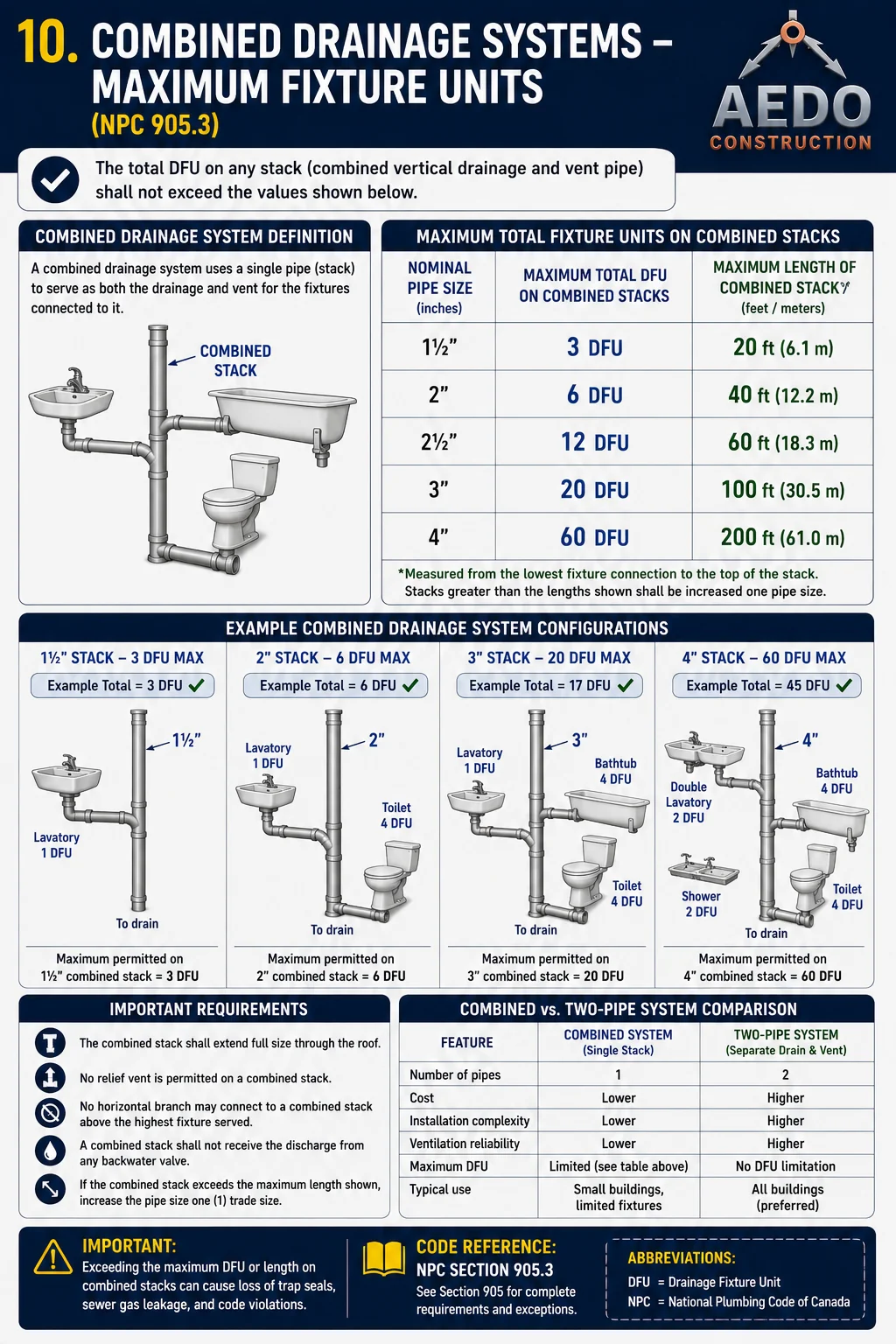
Combined stack (acting as both drain and vent) maximum DFU by size: 1½" = 3 DFU (max 6.1m); 2" = 6 DFU (max 12.2m); 2½" = 12 DFU (max 18.3m); 3" = 20 DFU (max 30.5m); 4" = 60 DFU (max 61.0m). Combined stacks shall extend full height to roof — no relief vent required. No horizontal branches may connect to a combined stack above the highest fixture served.
Venting — Visual Summary
Quick-reference diagrams for vent design
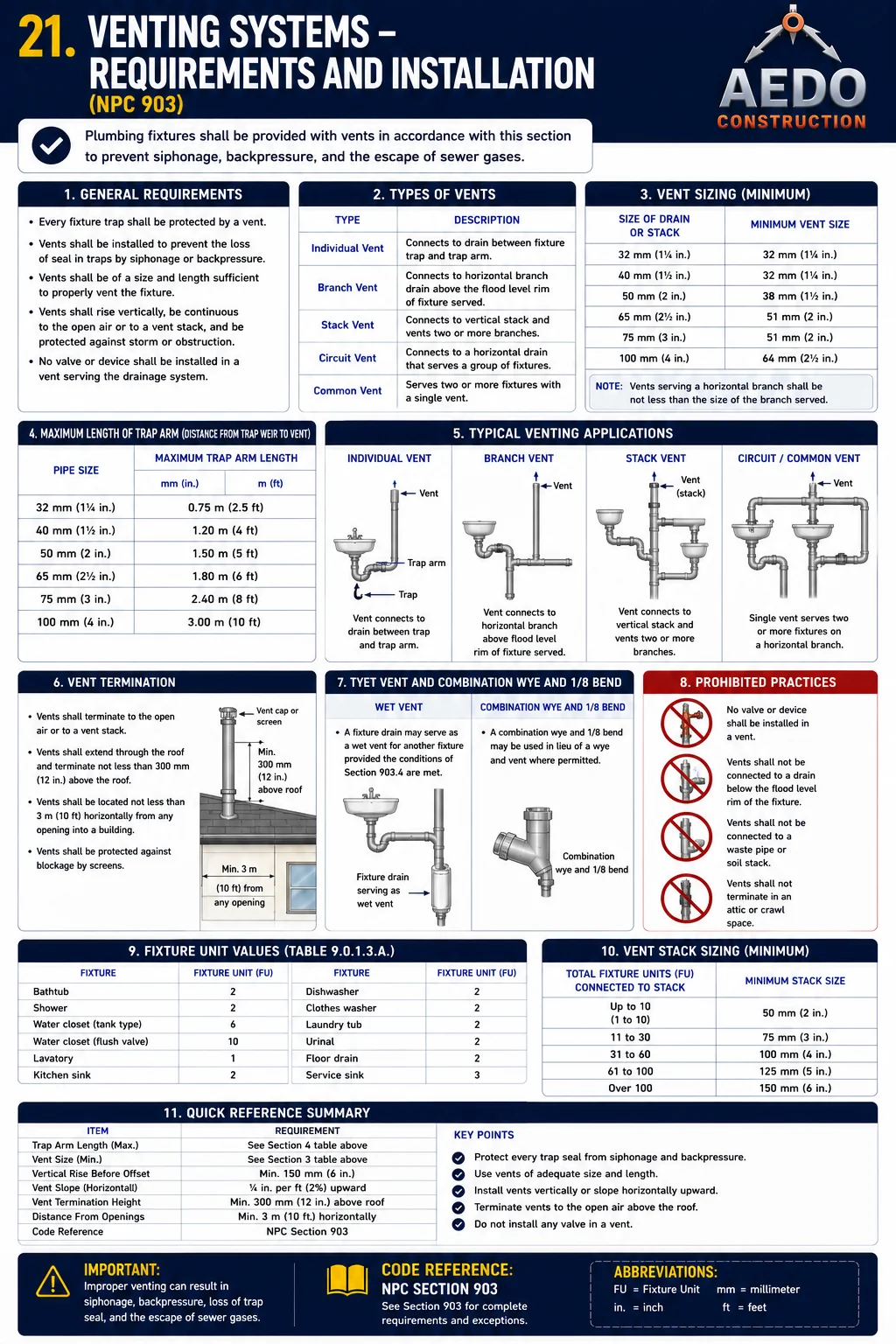
Venting systems — full overview. Types of vents (individual, branch, stack, circuit/common), minimum vent sizing by stack drain size, maximum trap-arm length, typical venting applications, vent termination, fixture-unit values, and prohibited practices.
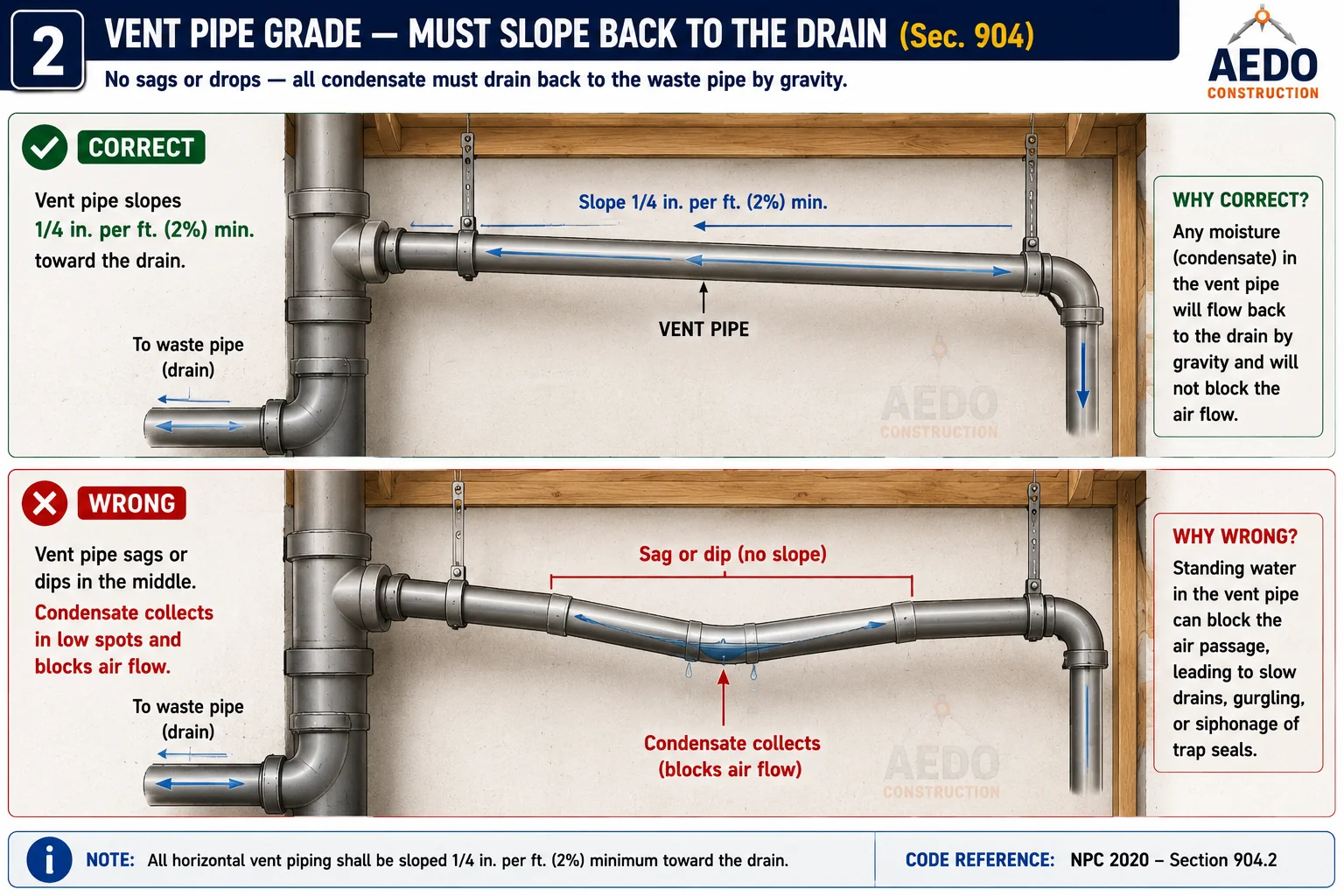
Vent pipe grade (§904). All horizontal vent piping shall slope at least 1/4 in. per ft (2%) back toward the drain so condensate drains by gravity — sags and dips collect water and block the air flow.
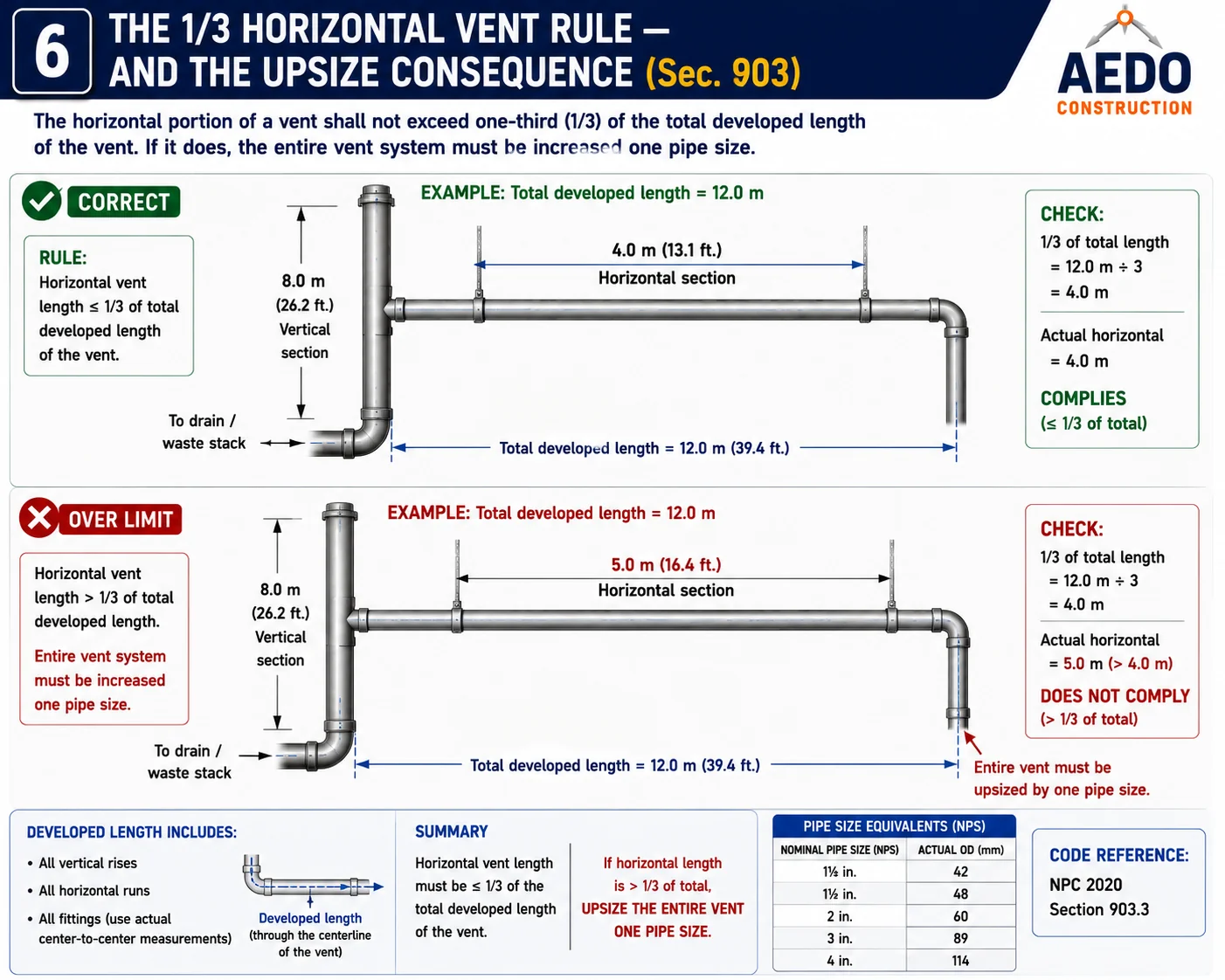
The 1/3 horizontal vent rule (§903). The horizontal portion of a vent shall not exceed one-third of the total developed length of the vent; if it does, the entire vent must be increased one pipe size.